

Growing Your Private Clinic: How to Attract More Patients
Practice Resources|April 15, 2026

MedReviews
MedReviews

Opening or expanding a private clinic requires, in most cases, a shift in mindset. If the formula for success was once based almost exclusively on clinical excellence and waiting for referrals from family doctors or word of mouth, today the rules of the game have changed entirely. An overburdened public health system is pushing patients to seek solutions in private medicine — but at the same time, competition among private doctors is intensifying.
The modern patient is a sophisticated healthcare consumer. They arrive at an appointment after thorough research: they've asked AI, read medical articles, checked reviews on doctor directories and compared different specialists. To stand out in this environment, being a skilled specialist is not enough — you need to run your clinic as a real business, with a marketing strategy, careful brand management and advanced management technologies.
Of course, every medical specialty is different and presents different marketing needs, but there are general guidelines relevant to any private clinic. We've written this guide as a practical professional toolkit to help you grow your private clinic, increase the number of relevant patients and build a quality long-term reputation.
Mindset Shift: From Doctor to Entrepreneur – Building Strategy and Differentiation
The most common strategic mistake among doctors opening a clinic is the desire to treat "everyone". This approach dilutes your professional message and puts you in direct competition with hundreds of other doctors with an identical profile.
The name of the game is sub-specialization. Once you focus your message on a specific problem or a defined target audience, you become the leading professional address for that field.
For example, instead of marketing yourself as an "expert psychiatrist", focus your title on "specialist in ADHD and anxiety treatment for executives and entrepreneurs". Instead of "plastic surgeon", emphasize "expertise in facial surgery preserving a natural appearance for women over 50".
When a patient suffers from a specific and painful problem, they're not looking for a general doctor — they're looking for the doctor who fits their problem exactly. This focus also allows you to charge a premium for your specific expertise.
Analyze the medical records of patients you most enjoyed treating in the past year and for whom you achieved the best results. What is their common denominator? Identify your sub-niche and build your marketing message around it.
Digital Presence and Authority
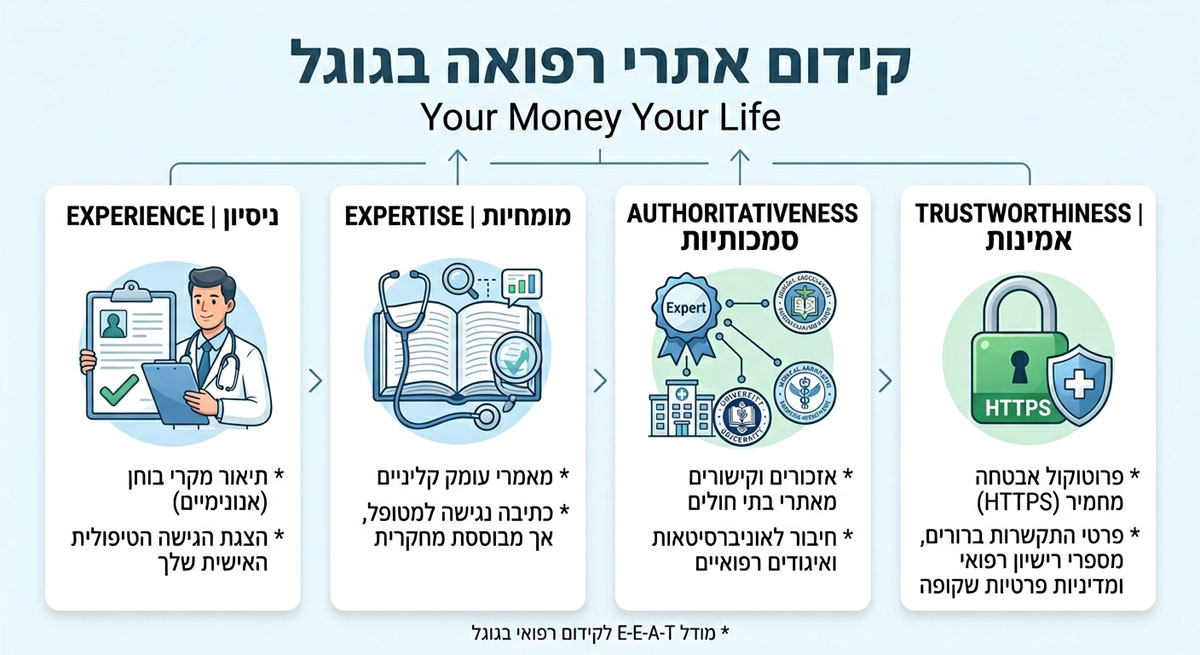
You've certainly heard this before, but that's simply the reality. A doctor's website has long ceased to be a static business card. Search engines, led by Google, classify medical websites under a category called Your Money or Your Life. That is, Google demands conclusive proof of your credibility before presenting you to a patient — the criteria for a medical website are higher than for other professionals.
Google relies on a model called E-E-A-T (Experience, Expertise, Authoritativeness, Trustworthiness):
● Experience: Include anonymous case studies on the site, explaining your therapeutic approach.
● Expertise: Publish in-depth clinical articles written in patient-accessible language, but based on current literature and medical research.
● Authoritativeness: Mentions and links to your site from recognized medical institutions (such as the hospital where you work, universities, medical associations).
● Trustworthiness: Strict security protocol on the site, clear contact details, license numbers displayed and a transparent privacy policy.
Optimization for AI-based search engines: Currently, only about 1% of website traffic comes from sources like ChatGPT or Gemini — but three years ago, nobody knew what these were. The advancement of artificial intelligence is moving at a dizzying pace.
The new engines don't just search for keywords — they read content to provide direct answers to patients. Therefore, your website must have a comprehensive Q&A section for every disease or treatment. The site's code should include structured data (Schema.org/MedicalEntity) to "explain" to the algorithm that you are a doctor, what your specialty is and which procedures you perform.
Medical Portals and Directories
Patients tend to search for doctors on centralized platforms that provide a sense of security, the ability to compare, and information about insurance plans. A strong presence on the leading medical directories is critical.
Don't settle for a dry CV. Upload a professional profile photo (half-body, in a white coat or tailored business attire, smiling and welcoming). Detail your medical worldview ("I believe..."). Most importantly — answer patient questions in the forums of these platforms. When a patient sees a detailed, patient and professional answer to a complex question, the likelihood that they will book an appointment specifically with the responding doctor increases sharply.
Content Marketing: Video, Podcasts and Community Building
The biggest barrier in private medicine is the trust barrier. Video is the most effective tool for breaking it. When a patient watches you explain a medical procedure, they learn to recognize your tone of voice, body language and level of empathy.
● YouTube as a search channel: YouTube is the second largest search engine in the world. Create a series of explainer videos ("What to expect from knee replacement surgery?", "How to identify symptoms of a herniated disc?"). Use titles that patients actually search for.
● Instagram Reels / TikTok: Even doctors in 2026 use these networks, but with great care. The goal is not entertainment, but "Micro-Learning" — short 30–60 second medical tips (for example, "3 myths about type 1 diabetes").
● Podcasts: A podcast is a powerful tool for building authority. You can produce your own podcast interviewing colleagues and analyzing case studies, or appear as an expert on popular health and lifestyle podcasts. Extended listening (30–40 minutes) creates deep intimacy between the doctor and the listener.
Frictionless Patient Experience
The best marketing goes to waste if the appointment booking process is cumbersome. Patients expect a smooth service experience, similar to booking a restaurant table or a flight ticket. The concept of "Frictionless" refers to removing every obstacle on the way to an appointment.
● Digital scheduling 24/7: Integrate a publicly accessible digital calendar into your clinic systems (via secure platforms), allowing patients to book an appointment in the middle of the night when pain or anxiety is bothering them.
● WhatsApp automation: WhatsApp is the primary communication tool in many countries. Integrate a smart AI-based chatbot into your clinic that can answer common technical questions (opening hours, directions, whether a specific insurance plan is accepted), collect preliminary medical documents and send automatic reminders the day before the appointment.
● Hybrid medicine and telemedicine: Offer initial consultations or follow-up appointments via video at an adjusted price. This expands your target audience nationwide, not just to the city where your clinic is located.
Smart Reputation Management and Active Review Collection
In the world of medicine, your name is your most valuable asset. Patients tend to write reviews mainly when they are unhappy (about waiting times, a receptionist's rudeness, etc.). If you don't actively manage your reputation, you risk a negative rating that doesn't reflect your professional level.
Make review requests a built-in part of the patient discharge process. Send an automatic WhatsApp message approximately 48 hours after treatment: "Hi [Name], I hope you're feeling well after your visit to Dr. [Name]'s clinic. We'd really appreciate it if you could share your experience to help other patients. To rate us on Google, click here:"
It's also recommended to actively manage your Google Business Profile. This is the first business card Google displays. Make sure it's updated, readable, filled with photos of the clinic (to create a sense of certainty), and has a high rating.
If someone writes a negative review about you, don't argue with them publicly. A proper response to a negative review looks like this: "Hello, we take all feedback very seriously. For reasons of medical confidentiality and patient privacy, we cannot address the details of the case publicly. We'd be happy for you to contact the clinic manager at [phone number] so we can look into the matter and assist you personally." This response conveys to other readers composure, professionalism and respect for confidentiality.
Paid Advertising (PPC) and Regulation
Paid advertising on Google (Google Ads) is a fast way to bring in patients, especially for private doctors, as it is based on active search intent.
However, medical marketing is subject to regulations and laws, with very specific prohibitions. For example:
● Prohibition on false representation: It is forbidden to use phrases like "the best doctor", "the most advanced clinic in the country", or "100% surgical success rate".
● Caution with before/after photos: These images are permitted in certain cases (mainly plastic and aesthetic surgery), but must be authentic, without misleading graphic editing, and reflect a realistic result that can be guaranteed to the average patient.
● Prohibition on fear-based advertising: It is forbidden to create campaigns designed to provoke anxiety in the patient in order to bring them to treatment.
● Benefit- and accessibility-based ads: Your ads should focus on availability, specific expertise and the solution you offer (e.g.: "Private consultation for fertility issues | Appointments available this week | Accepts health insurance").
Networking and Referral Circles
As significant as digital is, the power of colleague referrals has not diminished. The difference is that in 2026, networking is also done in a smart and systematic way.
● Identifying bottlenecks: Identify which doctors meet your patients just before they come to you. If you are a gynecologist specializing in high-risk pregnancies, build relationships with community gynecologists who are overloaded and happy to refer complex cases to an available private doctor.
● Quality introductory meetings: Send a message on LinkedIn or approach family doctors in your clinic's geographic area directly. Offer a short Zoom meeting or invite them for coffee to present the new treatment methods you apply.
● Creating a clinical ecosystem: Connect with complementary professionals. For example, a psychiatrist can create a referral circle with clinical psychologists and neurologists. These collaborations create a holistic envelope for the patient and ensure a mutual patient flow. Detailed and respectful summary and discharge letters sent to the referring doctor at the end of the consultation are a very high-quality networking tool.
Preventive Medicine and Retention
A patient who comes to you for one appointment is a success, but a stable and profitable clinic is built on returning patients or patients who consume peripheral services. In business terms, this is called Lifetime Value.
Instead of selling a single appointment, build a care package. For example, a cardiologist can offer an "annual prevention program" including consultation, periodic Holter monitoring, a session with a clinical nutritionist working at the clinic, and availability for WhatsApp questions.
A proactive outreach from the clinic (even by a medical receptionist) two weeks after surgery or a new medication adjustment to ask "how are you feeling?" not only prevents clinical complications, but creates an absolute sense of loyalty.
Data-Driven Clinic Management
You cannot manage a clinic on "gut feelings". To grow your clinic, you need to know your numbers and master your KPIs (Key Performance Indicators):
● Customer Acquisition Cost (CAC): How much does it cost you to bring in a new patient? If you pay for marketing per month and gain new patients as a result, is the cost per patient lower than your consultation fee? (Most likely yes, meaning the ROI is positive.)
● Call-to-appointment conversion rate: Out of every 10 people who call the clinic to inquire, how many actually book an appointment? If the number is below 50%, the problem may not be in your marketing, but in the receptionist team's call script or the appointment availability you offer.
● No-show rate: A scheduled appointment where the patient doesn't show up equals zero revenue, and also prevented another patient from receiving care. Reminder mechanisms and advance deposits where necessary will reduce this figure.
The Philosophical Angle
Beyond clinical expertise, the deepest growth of a clinic occurs when there is complete alignment between your personal values and your professional practice.
Successful doctors are those who dare to integrate their worldview into their medical practice and break the traditional — and sometimes rigid — structure of the medical establishment. The 2026 patient is looking for more than an accurate diagnosis — they're looking for a doctor who sees them "eye to eye", who deeply understands their social, cultural or gender context, and who creates a containing and safe space.
Whether your professional passion touches on gender-aware medicine, modern parenthood, social equality or even sustainability and the environment — don't be afraid to integrate this agenda into the clinic's identity. Building a clinic on principles that burn within you doesn't narrow your target audience — on the contrary; it is the most authentic, sustainable and precise way to attract patients who are loyal to your unique approach and personality.
Articles in the field of Practice Resources

Telemedicine 2026: The Comprehensive Guide for Doctors – Technologies, Practice and Limitations
The complete guide to telemedicine for doctors: the history of remote medicine, technologies, practical tips and of course - remote medicine with AI.
MedReviews

Integrating AI in Clinic Management: Innovation, Efficiency, and Everything in Between
How can artificial intelligence streamline your clinic? Discover practical and innovative AI tools for clinic management that will save you time and money while elevating the patient care experience
MedReviews

Reputation Management for Doctors: Protect Your Good Name Online
Reputation management for doctors: patients are searching for you on Google, AI and social media. The complete guide to building a credible image, handling reviews and protecting your good name online.
MedReviews

SEO for Doctors in the Age of Artificial Intelligence
The world of information search is changing, and SEO for doctors requires a new approach: professional content that creates value for users, consistent online presence, and building authority.
MedReviews

Physician Branding: How to Turn a New Clinic into a Leading Brand
Proper branding is not "aggressive selling", but rather your way of telling patients who you are, what you believe in, and why they can entrust their health specifically to your hands.
MedReviews

Information Security for Clinics
WhatsApp, personal email, shared passwords — everyday habits that could turn into a cyber incident. Is the data in your clinic truly secure?
MedReviews
Book an Appointment
The service provided through the website is not a medical service. Documentation and sensitive information should only be given to doctors.
About
MedReviews is Israel's most advanced and reliable doctor index, centralizing information and verified reviews on doctors and clinics. Part of Israel's leading review site group, we connect patients seeking quality medical care with top recommended doctors. We achieve this through rigorous verification technology ('crowd wisdom') and advanced filtering mechanisms, providing full transparency in the medical world and enabling informed choices.
Navigation
Contact UsAboutPrivacy PolicyTerms of ServiceAccessibilityMedical articlesPhoto GalleryList your practice on MedReviewsLog inSpecialist Doctors
DermatologistsGynecologistsOrthopedistsOphthalmologistsPlastic SurgeonsCardiologistsENT DoctorsPsychiatristsGeneral SurgeonsOncologistsAesthetic MedicineDentistsDisclaimer
The information and content displayed on this site is intended to provide informative information and expressive opinion on behalf of third parties only they are not a substitute for professional medical advice and should not be relied upon as such advice. Any use of the information on the site requires examination and verification with the relevant parties. Use of the site and its contents is the sole and complete responsibility of the user