

The Epidemic of Violence Against Medical Staff in Israel: Historical Overview, Causes, and Practical Tools for Response
Practice Resources|June 13, 2026

MedReviews
MedReviews
The images and reports have become an inseparable part of the news in recent years: a medical intern violently attacked in an emergency room in Be'er Sheva by a patient who wanted to jump the queue; an emergency room director at Meir Hospital slapped and doused with a cup of scalding coffee by an enraged escort; a nurse at a health clinic who met a tragic death after a patient set her on fire; and doctors threatened at gunpoint by family members demanding immediate treatment. The phenomenon is not unique to Israel — India recently saw massive protests following the rape and murder of a medical resident, and countries like Italy have begun stationing armed soldiers in hospital corridors to protect their staff.
The healthcare system, which is supposed to be an island of compassion, healing, and safety, has become a true battleground for many medical staff members. A comprehensive study published in 2021 by the Ministry of Health and the Ministry of Internal Security, covering more than 5,500 community clinic workers in Israel, revealed a grim picture: 75% of staff members experienced verbal violence from patients, and approximately 55% experienced violence from escorts, at least once in the past year.
The phenomenon of violence against medical teams in Israel is not new — it has been going on for many years. What are the systemic and psychological factors driving it? And what can medical teams do about it?
Violence in the Healthcare System: Roots of the Phenomenon and Its Development
Violence against medical teams in Israel is not a new phenomenon, but the system's response to it has undergone significant changes over recent decades. In the past, verbal and even physical violence was often regarded as an "occupational hazard" or an inherent part of professional burnout, especially in busy emergency rooms. However, toward the end of the 1990s, the system began to recognize this as a strategic failure.
In 1998 and 2000, the Ministry of Health began issuing director-general circulars instructing hospitals on how to prepare for incidents of violence, requiring the establishment of organized security and reporting systems. One of the first legislative steps on the issue came in 2011, when the Knesset passed in second and third readings the "Law for the Prevention of Violence in Treatment Institutions." This law granted, for the first time, the formal authority to institution directors to issue a warning letter and even deny entry (for up to six months) to a patient or escort who had committed physical or verbal violence or vandalized property.
However, the true breaking point came in March 2017. Nurse Tova Kararo, of blessed memory, was murdered at a Clalit Health Services branch in Holon when a patient doused her with flammable material and set her on fire. The shocking incident led to a general strike across the healthcare system and the establishment of a committee to eradicate and combat violence in the healthcare system.
The committee's conclusions proposed a multi-systemic approach based on prevention, deterrence, and organizational backing. Among other things, the committee emphasized the need to reduce workloads, design calming treatment environments, and create certainty for patients by improving communication and information accessibility. At the staff level, it was recommended to equip workers with clear training and procedures, and to provide them with full institutional "backing" — including the organization taking responsibility for filing police complaints and establishing a norm of halting treatment in cases of violence. Finally, in order to eradicate the perception that "violence pays," the committee recommended creating effective deterrence through harsher punishments, sanctions against violent patients (such as affecting future eligibility), alongside public education and awareness from an early age.
Then came the COVID-19 pandemic. At the outbreak of the pandemic in 2020, medical teams enjoyed unprecedented public appreciation, accompanied by applause from balconies. However, as the pandemic dragged on, psychological pressure, strict restrictions, quarantines, and uncertainty led to a sharp spike in violence levels. Studies showed how this stress was translated into violence against the teams enforcing Ministry of Health guidelines.
Today, the system contends with a persistent, aggressive wave of violence. We witness cases of weapons being drawn inside emergency rooms, threats on the lives of doctors who treated family members, and serious physical injuries. The 2021 government study shattered another myth: violence is not confined to emergency rooms alone. Community clinics, pharmacies, and family medicine clinics suffer significant rates of violence, while many clinics lack basic security measures such as panic buttons or physical security guards.
What Drives a Patient to Attack the Person Trying to Heal Them?
To address the phenomenon, one must first understand its motivations. Violence in the healthcare system is composed of a triangle of factors: the patient's condition, interpersonal dynamics, and systemic failures.
1. Systemic failures and infrastructure overload: The primary cause leading to violence, according to staff reports themselves, is long waiting times. According to the 2021 study, approximately 29.3% of violent incidents stemmed from prolonged waiting. When a patient who is in pain, worried, or suffering is forced to wait hours for service in an overburdened and under-resourced system, they may become frustrated and violent. Approximately 31% of violent incidents stemmed from patients who arrived without an appointment and wanted to be seen by the doctor.
2. Medical disappointment and unmet expectations: Approximately 17.1% of violence cases in community clinics stem from staff refusal to fulfill a specific patient demand. This is especially common around refusals to issue prescriptions (particularly for narcotic painkillers, psychiatric medications, or medical cannabis), refusals to provide sick notes without justification, or refusals to provide referrals and commitment forms.
3. Emotional distress, psychiatric conditions, and substance use: Another basis for violence lies in the patient's clinical condition. Approximately 19.5% of cases are attributed to the patient's mental distress, and approximately 8.1% stem from the influence of drugs or alcohol. Patients in extreme situations, suffering from acute pain, existential anxiety about their own fate or that of their loved ones, lose their self-regulation mechanisms.
4. Decline in the doctor's status as an authority: Whereas in the past the doctor's status was unquestioned and society naturally afforded them respect, today there is a constant erosion of that authority. The accessibility of information on the internet causes many patients to arrive with a pre-formed "diagnosis," viewing the doctor merely as a rubber stamp for carrying out their wishes. When the doctor disagrees with their lay opinion, the situation can quickly deteriorate into verbal and physical confrontation.
5. The impact of war and a surge in PTSD rates: The security situation and the prolonged war have left a deep mark on Israeli society, leading to a sharp rise in the number of civilians and security forces personnel suffering from post-traumatic stress disorder, anxiety, and acute stress states. One of the well-known manifestations of PTSD is difficulty with emotional regulation, hyperarousal, and a low frustration threshold. For a patient coping with trauma, seemingly trivial situations — such as crowding and noise in the waiting room, a sense of helplessness in the face of a bureaucratic system, or a feeling of not being heard — can serve as an overwhelming trigger. In such cases, violence does not stem from contempt or malicious intent, but from distress and "invisible" wounds that have yet to heal.
Early Identification of a Patient at Risk of Violence
Violence at a clinic rarely occurs out of the blue. In the vast majority of cases (approximately 80% according to hospital data), there are "warning signs" that can be identified in order to prevent an outburst or prepare for one. Developing the skill of "reading the room" is an essential tool for every medical staff member. New technologies are even attempting to do this automatically using artificial intelligence that analyzes stress levels in the voice and body language of those present in the waiting room. But until the technology is implemented in every clinic, the responsibility falls on the staff.
How do you identify the escalation sequence?
Behavioral signs and body language:
● Motor restlessness: A patient or escort who repeatedly stands up and sits down, paces back and forth in the waiting room, or approaches the reception desk with unusually high frequency.
● Invasion of personal space: Threatening physical approach toward the receptionist or doctor, leaning over the counter, or standing pressed against the treatment room door.
● Visible physical tension: Clenched fists, tense facial muscles, heavy and rapid breathing, a fixed and focused stare that does not release from the staff member.
Verbal signs:
● Changes in volume and tone of speech: Gradual raising of the voice, use of a demanding, sarcastic, or dismissive tone.
● Repeated complaints: Compulsive repetition of grievances against the system ("I've been waiting here for two hours already," "Nobody pays attention to me").
● Offensive language and implied threats: Use of profanity (even if not directed at the staff but into "thin air"), threats to file complaints, threats to go to the media ("I'll shame you on Facebook"), or implied physical threats ("You don't know who you're dealing with").
Circumstantial risk factors:
● An especially long wait that has greatly exceeded the original appointment time.
● Multiple escorts accompanying the same patient (a phenomenon that frequently produces a "herd effect" of agitation).
● A patient known to the system with a history of violent behavior or addictions.
The most important rule in early identification is do not ignore it. Research shows that ignoring a patient's restlessness (in the hope that they will "calm down on their own") typically produces the opposite result and accelerates the escalation.
Creating a Safe and Calming Medical Environment
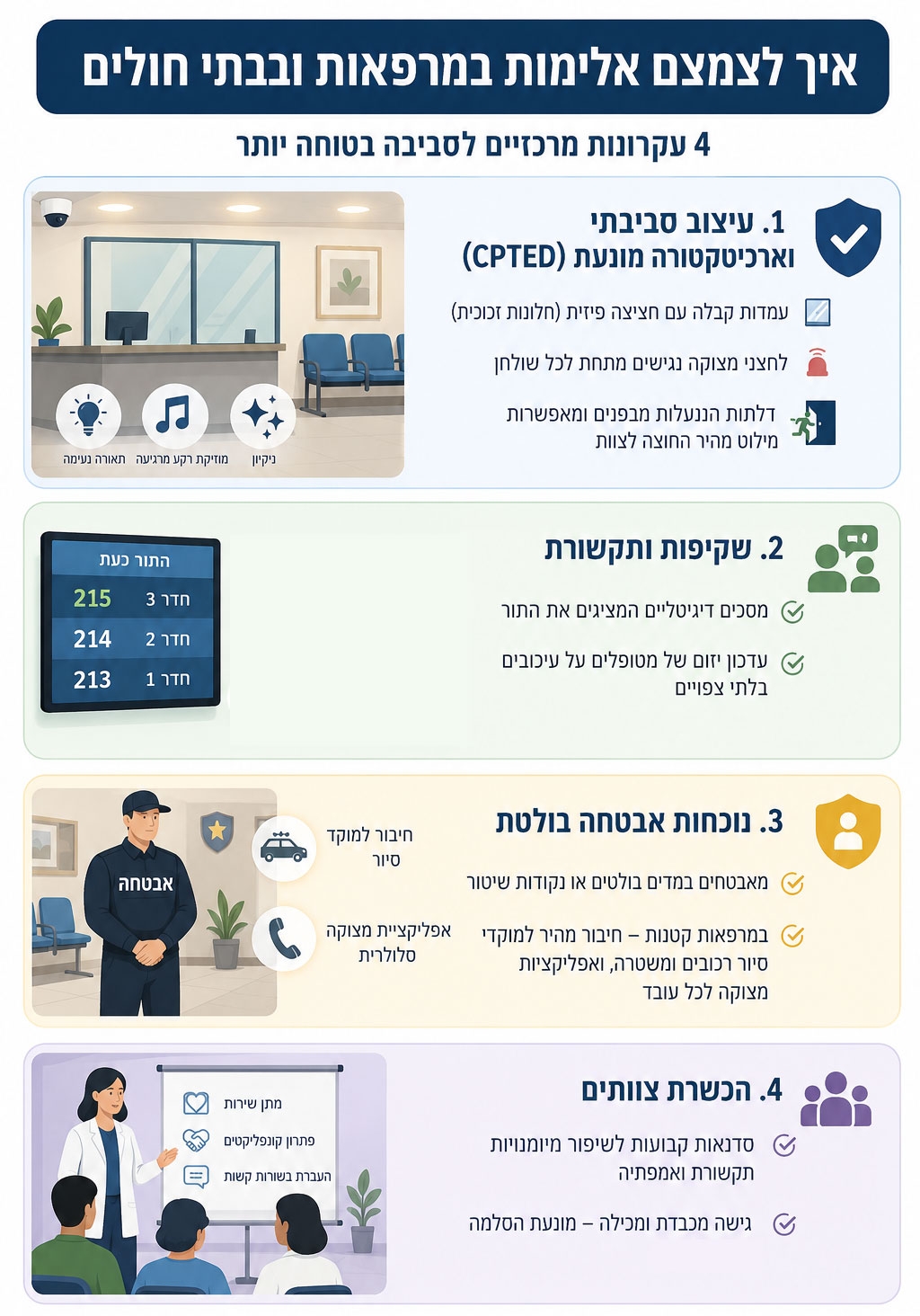
Preventing violence begins before the patient even meets the doctor. It lies in the design of the environment, working procedures, and institutional policy.
1. Environmental design and preventive architecture (CPTED): The Ministry of Health now instructs that waiting areas be designed in a way that reduces anxiety and stress. The concept of Crime Prevention Through Environmental Design includes pleasant lighting, calming background music, and maintaining cleanliness. Beyond this, critical protective elements must be implemented: creating reception stations with physical barriers (such as wide glass windows), installing panic buttons accessible from beneath every office desk, and using doors that can be locked from the inside in an emergency while also allowing staff rapid escape.
2. Transparency and communication: Uncertainty is the fuel of anger. When a patient knows why they are waiting and how much time remains, their anxiety drops sharply. It is recommended to use digital screens displaying the queue status, but more importantly — it is the role of reception staff to proactively update patients about unexpected delays ("Dr. Israeli is delayed due to a medical emergency; the wait will be extended by approximately half an hour. We apologize for the inconvenience").
3. Visible security presence: Stationing security guards in prominent uniforms (and in the case of hospitals, policing points) constitutes a significant deterrent. In small community clinics where there is no budget for a permanent security guard, reliance should be placed on direct and rapid connection to mobile patrol units of security companies or police, and on distress apps for every employee.
4. Staff training: Empathy and communication skills play a critical role in violence prevention. Medical teams should undergo regular workshops on service delivery, conflict resolution, and the delivery of difficult news. A doctor who projects coldness and impatience may, unintentionally, ignite a confrontation.
How Doctors Can Handle a Violent Incident
It is impossible to prevent every violent incident. Therefore, when a patient or escort crosses the line and displays verbal or physical aggression, one must act according to the principles of de-escalation and personal safety.
Stage one: physical protection and personal safety
● Safety distance: Maintain a distance of at least two arm-lengths between yourself and the aggressive individual. Do not enter their personal space, as this may be interpreted as a threat on your part.
● Escape route: Never allow a patient to block your path to the door. Ensure that your work desk is positioned so that you are closer to the exit than the patient.
● Non-confrontational body language: Do not cross your arms (this conveys defensiveness and rigidity) and do not point an accusatory finger. Keep your hands visible and at waist height, in a relaxed posture. Never turn your back on an agitated individual.
Stage two: verbal de-escalation
● Calling for help: This is the moment to press the panic button or use the internal "code word" established at your clinic to signal colleagues to summon security without shouting.
● Tone of voice: Speak in a calm, quiet, and slow voice. Do not try to out-shout the patient. Often, when you lower your voice, the patient will be forced to lower theirs in order to hear you.
● Validation: Angry people want to be seen and heard. Use empathetic phrases that validate their feelings without condoning their behavior. For example: "I can see you're in a great deal of pain and I understand you're frustrated with the wait. Let's see what I can do to help you right now."
● Avoid arguments and moral lectures: This is not the time to educate the patient or explain at length the health fund's procedures. Do not use phrases like "Calm down immediately" or "You're not allowed to speak to me like that" — these phrases are like adding fuel to a fire.
● Setting clear but respectful boundaries: If the verbal violence continues, set a boundary matter-of-factly: "I want to help you, but I cannot continue the treatment while you are shouting and using that kind of language. Please lower your voice so we can continue."
Stage three: disengaging when there is physical danger
If the individual picks up an object, raises their hand, or threatens real physical violence — end the incident immediately. Leave the room, lock the door if possible, and move other patients away from the danger zone. Your role is to provide medical care, not to serve as a special forces operative. Your life and physical safety take precedence over everything else. Leave the physical handling of the aggressor to security personnel and the Israel Police.
After the Storm: The Importance of Reporting and Support
One of the troubling findings emerging from surveys is the under-reporting within the system. Many doctors and nurses who absorb insults on a daily basis do not even bother to report them because they perceive it as "part of the job" or out of a sense that "the police won't do anything anyway" (only approximately 9.3% of cases in the survey are reported to the police, with the remainder closed internally within the system).
Reporting is critical for two main reasons:
1. Exhausting legal remedies and deterrence: Without a formal complaint to the police and the security apparatus of the health fund or hospital, serial aggressors will continue their violent campaign from clinic to clinic. New laws now make it possible to distance violent patients and even deny them service at the specific clinic where the attack occurred.
2. Systemic improvement: Statistical data is the only way for system managers to allocate security budgets where they are truly needed.
In addition to reporting, the care of the injured employee must not be neglected. A violent incident leaves scars. Surveys found that over a third of those affected reported a significant decline in their quality of life following an incident, the onset of anxiety, psychological burnout, and in extreme cases even symptoms of post-traumatic stress disorder (PTSD) and thoughts of leaving the profession. The management of medical institutions must provide immediate psychological support, guidance, and accompaniment of the employee throughout any legal proceedings that may follow.
Good Medicine Begins with Personal Safety
Violence against medical teams is a malignant disease striking at the very heart of Israeli society. It harms not only the doctor or nurse who absorbs the blow or the insult, but the entire patient population, whose quality of care declines when the staff operates in constant fear and burnout.
The solution requires a national combined effort: harsher sentencing in the courts, massive investment in preventive security by the Ministry of Health, improved infrastructure to reduce workloads, and re-educating the public to respect medical professionals. In parallel, medical teams must equip themselves with the knowledge, tools, and communication skills that will enable them to identify risk situations in advance, neutralize them wherever possible, and protect themselves in an emergency. Good medicine begins, above all, with a safe environment.
Articles in the field of Practice Resources

Managing an Instagram Page for Doctors: A Practical Guide and Tips
Instagram is a search engine for everything. How to turn feed scrolling into clinic appointments? The complete guide for doctors: creating Reels, working with influencers, and proper management
MedReviews

Networking for Doctors: The Complete Guide to Building a Network That Works for You
In today's medical world, networking is no longer just a buzzword reserved for sales reps, but an important strategic tool that you should be utilizing.
MedReviews

Reputation Management for Doctors: Protect Your Good Name Online
Reputation management for doctors: patients are searching for you on Google, AI and social media. The complete guide to building a credible image, handling reviews and protecting your good name online.
MedReviews

Excellent Doctor, Mediocre Service? How to Make Your Clinic Excel in Customer Experience Too
Mediocre customer service can undermine you as doctors. Learn how to make your clinic excel in customer experience: tips for managing WhatsApp, email, phone, and more.
MedReviews

Information Security for Clinics
WhatsApp, personal email, shared passwords — everyday habits that could turn into a cyber incident. Is the data in your clinic truly secure?
MedReviews

Doctor TikTok: The Complete Guide for Physicians to Succeed on the World's Fastest-Growing Social Network
The complete guide for doctors looking to build a TikTok presence: case study analysis, adaptation for the Israeli audience, and practical tips
MedReviews
Book an Appointment
The service provided through the website is not a medical service. Documentation and sensitive information should only be given to doctors.
About
MedReviews is Israel's most advanced and reliable doctor index, centralizing information and verified reviews on doctors and clinics. Part of Israel's leading review site group, we connect patients seeking quality medical care with top recommended doctors. We achieve this through rigorous verification technology ('crowd wisdom') and advanced filtering mechanisms, providing full transparency in the medical world and enabling informed choices.
Navigation
Contact UsAboutPrivacy PolicyTerms of ServiceAccessibilityMedical articlesPhoto GalleryList your practice on MedReviewsLog inSpecialist Doctors
DermatologistsGynecologistsOrthopedistsOphthalmologistsPlastic SurgeonsCardiologistsENT DoctorsPsychiatristsGeneral SurgeonsOncologistsAesthetic MedicineDentistsDisclaimer
The information and content displayed on this site is intended to provide informative information and expressive opinion on behalf of third parties only they are not a substitute for professional medical advice and should not be relied upon as such advice. Any use of the information on the site requires examination and verification with the relevant parties. Use of the site and its contents is the sole and complete responsibility of the user