

What Patients See About You on Google — and How to Take Control of Your Online Reputation
Practice Resources|June 17, 2026

MedReviews
MedReviews
What do your potential patients see when they search for information about you online? Do you ever Google your own name to check the state of your online reputation? Has it ever happened that you found yourself surprised or angered by inaccurate information published about you, only to realize it was a reputational blow that would be difficult to undo?
Many doctors hold the (mistaken, it should be noted) belief that if they haven't built a website or opened a business Facebook page, they simply "don't exist" online and therefore have nothing to manage. The reality, especially in 2026, is entirely different. The internet doesn't like empty spaces. If you don't create your own digital presence, someone else will create it for you — and most of the time, their interests will not align with yours.
The Illusion: "If I Have No Website, My Presence Is Neutral"
There is no such thing as a "neutral presence" — not in medicine and not in any other profession. Data indicates that 82% of patients conduct online research on doctors and healthcare providers before booking an appointment. When a patient searches your name, they expect to see professional, organized, and credible information. If you have no home website or official profile that you manage, the search engine will display whatever it has. And what it has, typically, are automatic directories, various ranking sites, and pages on websites of clinics where you worked in the past.
For the patient, the first results on Google are the "truth" about you. If the first result shows an incorrect address, a disconnected phone number, or a low rating because of an unfriendly receptionist who worked with you three years ago — that is the reality the patient encounters, and that is most likely also the reason they will choose a different doctor.
The Directory Trap: When Your Information Becomes Someone Else's Product
One of the biggest problems doctors encounter is the phenomenon of "independent directories." These are websites that collect public information from various sources (such as the Ministry of Health database, old phone books, or previous online records) and create a page in your name, without your permission and without your knowledge. Their purpose is simple: to attract traffic from users searching for you, in order to profit from advertising.
This model creates several significant problems for you:
1. Inaccurate and outdated information: These directories do not update in real time. They may present you as specialists in a narrow field you practiced in the past, display incorrect office hours, or direct patients to a phone number that no longer belongs to you. A patient who tries calling a wrong number three times will simply give up and move on to the next doctor. 2. Advertising your competitors on your back: In many free directories, the page bearing your name serves as an advertising platform. A patient comes to read about you and finds a colorful banner saying: "Looking for an orthopedist? Book an appointment now with Dr. Cohen!" (who is, of course, your direct competitor who paid the directory for sponsored placement). 3. No ability to manage the information: Come across such a page and want to correct an error? You will often find it an exhausting task. There is no simple edit button. You will need to contact a customer service that may or may not exist, send proof of identity, and wait weeks. In some cases, directories will demand you pay a monthly subscription just to gain basic editing rights over your own name. In many cases you will simply find there is nobody to talk to at all.
The "Previous Clinic" Syndrome: When You Keep Generating Leads for Others
Another frustrating phenomenon relates to previous employers. Many doctors begin their careers at large medical centers, shared private clinics, or clinic networks, and at some point branch out on their own.
The problem is that these clinics know your name drives Google searches. They will often "forget" to remove your page from their website for months or even years after you have left. The result? A patient searches for you, lands on the previous clinic's website, calls to book an appointment with you, and is met by the receptionist's classic response: "The doctor is no longer seeing patients here, but we have Dr. Levi who is an excellent specialist in the same field — would you like me to book you an appointment with him?"
Without realizing it, you continue to serve as a marketing pipeline funneling clients directly into the hands of competitors or former employers, instead of having those patients reach your independent practice.
Real-World Examples of Losing Control Over Your Online Reputation
To understand just how absurd the loss of control can become, here are some examples of situations doctors face online:
● The 1-star review about the parking: Research shows that the majority of complaints and negative reviews that patients leave online are not related to the quality of medical care at all, but to administrative issues such as waiting times, billing problems, or an unfriendly receptionist. A doctor may discover they have a 2.5-star rating on some random directory, solely because four years ago there was a parking problem beneath the clinic where they worked. Since the doctor has no control over the page, they cannot even respond to the review, explain the situation, or show prospective patients that they care. ● Confusing multiple specialties: An internist who completed a subspecialty in rheumatology and wants to focus exclusively on that field in their private practice may find themselves flooded with calls from patients requesting general medical certificates for the flu. Why? Because five different directories still categorize them under "general medicine" or "family medicine," and they struggle to erase that history. ● The "fake news" of opening hours: A patient in pain arrives at 7 PM at an address they found on Google, only to find a clothing store. The clinic relocated two years ago and its opening hours changed. The frustrated patient will not blame the directory — they will blame the doctor, and will most likely leave an angry review.
What Do the Numbers Say?
In an era where we manage our bank accounts, grocery shopping, and vacations through a screen, the way patients choose their doctor has also undergone a digital transformation. Here are some figures that illustrate just how critical digital reputation has become:
● 84% of patients read online reviews: According to a recent report by rater8 (a company specializing in medical reputation management), the vast majority of patients check reviews of healthcare providers online as a basic step before booking an appointment. Moreover — 51% read at least 6 reviews before making a decision. ● 40% will cancel an appointment because of a single negative review: 40% of patients changed their plans — meaning they cancelled an existing appointment or decided not to book with a particular doctor — solely because of negative feedback they read about them online. ● Google is (still) the main battleground: Approximately 84% of patients use Google Reviews as their primary platform for checking doctors. ● 57% do not leave a review on their own initiative: Despite the enormous influence reviews have on their decisions, 57% of patients admit they almost never leave a review for their doctor on their own initiative.
In other words, your silent patients are probably your satisfied patients, who will complete a successful treatment and move on with their lives without leaving any digital trace of your success. The ones who do bother to "speak up" online are typically the patient who is angry about the receptionist or the waiting time.
The conclusion is clear: if you are not proactive about asking for and collecting positive reviews from your good patients (via automated SMS messages or a personal request), the only voice that will stand out online and shape your image will be the voice of the frustrated.
The AI Search Engine Revolution
As if the situation weren't complex enough, we are now experiencing the explosion of artificial intelligence. Patients no longer just type a doctor's name — they ask AI open-ended questions like: "Who is the most recommended plastic surgeon in the Tel Aviv area with good reviews about personal attention?"
How does artificial intelligence decide who to display? It scans the web, cross-references information, and looks for consistent data. If the information about you is scattered, contradictory (one directory says you are in Tel Aviv, another says Rishon LeZion), full of negative reviews with no responses, or simply absent — the AI will simply ignore you and recommend a colleague whose digital presence is organized, credible, and clear.
From Reactive to Proactive: How to Take Back Control
You absolutely can control the flow of information about you online. Here are some important tips:
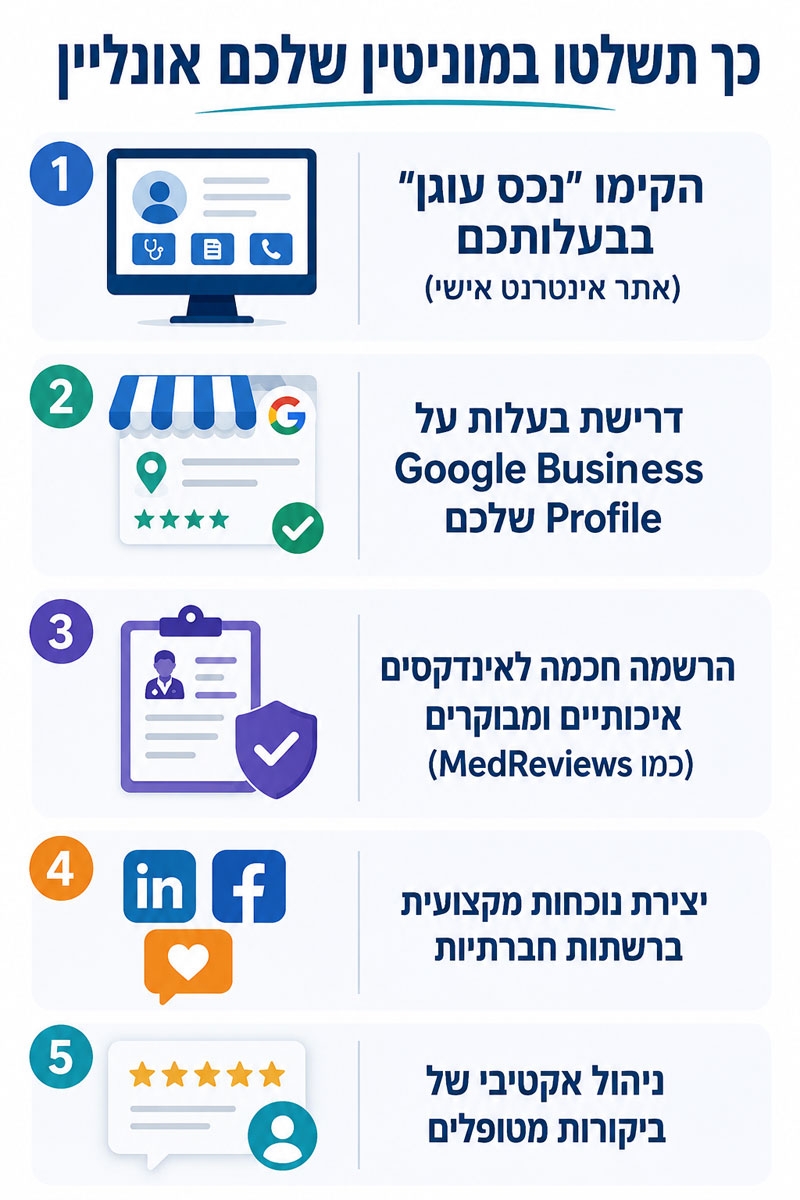
1. Build an "anchor asset" that you own (a personal website): The best way to beat automatic directories is to create an official website. Search engines give greater weight to an official website. A professional site doesn't have to be a complex technological monster; a landing page or a clean image site that includes your areas of expertise, a professional headshot, a list of treatments, your CV, and updated contact details will do an excellent job. There you control the narrative 100%.
2. Claim ownership of your Google Business Profile: This is probably the most critical and fastest step you can take. Your Google business card appears on the side of the screen (or at the top on mobile) when someone searches your name. Check whether Google has already created an automatic card for you, and click "Claim this business." After a brief verification process, you can enter accurate opening hours, address, appointment phone number, clinic photos, and most importantly — you can see the reviews posted there and respond to them professionally and respectfully (while maintaining medical confidentiality, of course).
3. Smart registration on quality, curated directories (such as MedReviews): Not all directories are "bad." The problem is with directories that create profiles without oversight and use them as a pirate billboard. By contrast, professional, established, and quality platforms such as MedReviews are an excellent working tool for doctors. On quality directories like these, you register proactively, verify your identity, and have full control over the content displayed.
4. Creating a professional presence on social media: You don't have to film TikTok dances in a white coat if that's not your style. But opening a professional LinkedIn profile detailing your clinical experience, or a business Facebook page where you periodically share a medical tip or a comment on health news, captures "digital real estate." The more quality pages you create under your control, the more unwanted pages will be pushed to Google's second and third pages (which, as is well known, almost no patient ever reaches).
5. Active management of patient reviews: Satisfied patients tend to stay silent — and you need to help them speak up. At the end of a successful treatment, when a patient thanks you for your help, don't be shy about saying with a smile: "I'm glad to hear it. It would help me a great deal if you could write a few kind words on Google or MedReviews — it helps other patients find their way to proper care." It is also possible (and advisable) to implement an automated system that sends the patient an SMS message with a rating request after their visit. Once you start systematically collecting dozens of 4- and 5-star reviews, a single review about "no parking" will become meaningless in a sea of warm recommendations. In addition, it is important to always respond — to both positive and negative reviews — in a matter-of-fact, empathetic, and professional manner. A professional response to an angry review impresses prospective patients far more than silence.
Your Reputation Is Your Most Valuable Asset
At the end of the day, a doctor's good name is built through hard work, professionalism, hundreds of hours in surgery, brilliant diagnoses, and sleepless nights. It simply makes no sense to allow a blind algorithm or an amateurish directory website to damage this life's work simply through inattention.
The time has come to move from the attitude of "I'm a doctor, not a computer person" to the approach of a professional who protects their good name. Hire professional help and take ownership of your digital assets. Set a high standard for the information published about you, and make sure that when the next patient types your name into Google — they see exactly the excellent doctor you truly are.
Articles in the field of Practice Resources

Managing an Instagram Page for Doctors: A Practical Guide and Tips
Instagram is a search engine for everything. How to turn feed scrolling into clinic appointments? The complete guide for doctors: creating Reels, working with influencers, and proper management
MedReviews

Physician Branding: How to Turn a New Clinic into a Leading Brand
Proper branding is not "aggressive selling", but rather your way of telling patients who you are, what you believe in, and why they can entrust their health specifically to your hands.
MedReviews

Growing Your Private Clinic: How to Attract More Patients
A practical guide to growing your private clinic: from differentiation and digital presence to reputation management, smart networking and essential business metrics
MedReviews

YouTube Marketing for Doctors: Practical Tips for Promoting Your Clinic
Promoting your clinic on YouTube requires considerable investment, but the return is digital assets that last for years. Let's learn how to do it
MedReviews

Information Security for Clinics
WhatsApp, personal email, shared passwords — everyday habits that could turn into a cyber incident. Is the data in your clinic truly secure?
MedReviews

Excellent Doctor, Mediocre Service? How to Make Your Clinic Excel in Customer Experience Too
Mediocre customer service can undermine you as doctors. Learn how to make your clinic excel in customer experience: tips for managing WhatsApp, email, phone, and more.
MedReviews
Book an Appointment
The service provided through the website is not a medical service. Documentation and sensitive information should only be given to doctors.
About
MedReviews is Israel's most advanced and reliable doctor index, centralizing information and verified reviews on doctors and clinics. Part of Israel's leading review site group, we connect patients seeking quality medical care with top recommended doctors. We achieve this through rigorous verification technology ('crowd wisdom') and advanced filtering mechanisms, providing full transparency in the medical world and enabling informed choices.
Navigation
Contact UsAboutPrivacy PolicyTerms of ServiceAccessibilityMedical articlesPhoto GalleryList your practice on MedReviewsLog inSpecialist Doctors
DermatologistsGynecologistsOrthopedistsOphthalmologistsPlastic SurgeonsCardiologistsENT DoctorsPsychiatristsGeneral SurgeonsOncologistsAesthetic MedicineDentistsDisclaimer
The information and content displayed on this site is intended to provide informative information and expressive opinion on behalf of third parties only they are not a substitute for professional medical advice and should not be relied upon as such advice. Any use of the information on the site requires examination and verification with the relevant parties. Use of the site and its contents is the sole and complete responsibility of the user