

How Doctors Appear in AI Engines Like ChatGPT and Gemini
Practice Resources|July 10, 2026

MedReviews
MedReviews
It's a new world out there, and we're not exaggerating. We're witnessing a big bang in the world of search, one that is completely changing the way patients consume medical information, look for diagnoses, and find specialists. Where a patient used to type a short phrase like "left knee pain" and scroll through dozens of blue links, today they hold a flowing conversation with generative AI engines like ChatGPT, Gemini, or Claude.
Today's patients feed these engines their blood test results, describe complex symptoms in full paragraphs, and ask specific questions like: "I'm 55, I take blood pressure medication, and I have left knee pain that gets worse when climbing stairs — what's the possible diagnosis, and which specialist in the central region should I see?" The AI analyzes, summarizes, and delivers the patient one organized answer. This shift from traditional search engine optimization (SEO) to generative engine optimization (GEO) requires doctors to rethink their marketing and digital approach entirely.
The Illusion of "Ranking #1 on AI"
Rapid technological change always attracts marketers who make false promises, so it's wise not to open your wallet for anyone promising you the moon. You've probably already come across offers claiming to "rank your clinic #1 on ChatGPT" or "dominate AI results." When you hear promises like these, understand that you're dealing with charlatans.
Unlike Google's traditional search engine, which is based on a single central index and visible data measurable through tools like Google Search Console, the AI world works completely differently. First, there is no public data system or tool that shows how many times your brand appeared in a given language model's answers — we're currently operating inside a "black box." Second, there are dozens of different models and engines, each pulling information from different sources and updating at a different frequency.
Beyond that, the concept of "ranking #1" simply no longer exists. AI generates a dynamic, one-time answer for each user based on their unique context. One patient asking about a "recommended dermatologist for acne" will get an answer shaped by their previous conversation history, their geographic location, and the specific phrasing they used. Another patient asking the exact same question, but using different wording or a different engine, will get a completely different output. Large language models (LLMs) calculate word probabilities — they don't rank websites — so any promise of a "guaranteed position" reflects either a basic misunderstanding of the technology or plain fraud.
A Snapshot: Medical Information Searches
To understand how we should act, we need to look at the numbers on the ground. A comprehensive study by Fractl and Search Engine Land, which examined more than a million keywords with a search volume of at least 10,000 per month, reveals that the health and medicine sector (HealthTech) is undergoing a shakeup in search. This sector shows a 36.5% collapse in traditional search volume, compared to only 14.1% growth in alternative searches in the same sector (a 0.4x ratio). The reason lies in the nature of medical searches: they are "information-heavy" searches. When a patient asks an informational question like "what are the side effects of drug X" or "how is diabetes diagnosed," the chatbot provides a full, comprehensive, satisfying answer right within the chat window. The patient has no reason to click through to your website.
99.6% of search volume in the health sector is unbranded — meaning users perform general searches about diseases, symptoms, or treatments without naming a specific doctor or medical institution. And that makes sense, since the average user doesn't come from a medical background.
AI models are replacing these general searches with remarkable ease. However, this is exactly where your opportunity lies. While AI can answer the "what" (what's the disease, what's the treatment), it cannot perform the treatment itself. It has to recommend the "who." Doctors who manage to become a brand that AI trusts will gain patients who already received the general medical information from the machine, and now want to book an appointment with the specialist the machine mentioned in its answer.
Building Authority in a YMYL-Governed Environment
Now that it's clear we're no longer fighting over basic informational queries, but for the right to become the "brand" or professional that AI recommends, we need to understand how these engines choose their sources. In medicine, the rules of the game are far stricter than in any other industry. Google and AI developers like OpenAI have classified health, finance, and safety under the umbrella of YMYL (Your Money or Your Life).
The meaning of YMYL is that search engines and language models understand that incorrect information in these fields can cause real physical, psychological, or financial harm to the user. Therefore, the algorithms apply especially strict filters and demand an especially high level of authority, trustworthiness, and expertise. A language model won't take a risk and recommend a doctor just because they have a nice website or a lot of TikTok followers. It will recommend a doctor the algorithm identifies through broad consensus as a genuine expert, based on the digital "X-ray" of their presence across the web.
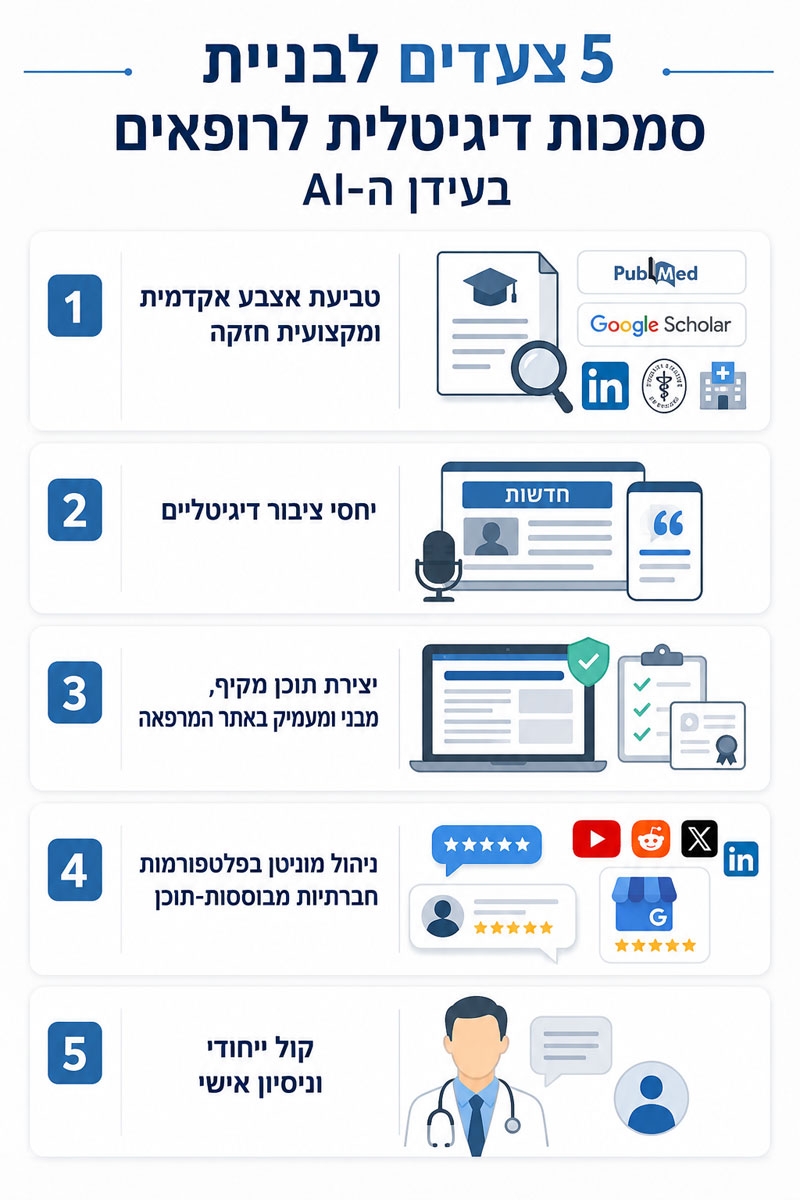
How do you actually build this presence?
- A strong academic and professional footprint: Language models scan professional databases to understand who is genuinely considered an authority in their field. Make sure your name appears in the right context in these databases. Publish professional articles and make sure they appear on PubMed, Google Scholar, and online medical journals. Furthermore, make sure your professional profiles on LinkedIn, Israeli medical associations (like the Israeli Medical Association), and the websites of the hospitals you work at are fully up to date. When AI cross-references information and sees your name appearing on your private clinic's website, in the Medical Association's index, and as an author on a recent study, it builds you up as a trustworthy entity.
- Digital PR: One of the strongest signals for AI is mentions on authoritative sites you don't control. If you're interviewed for an article on a major news site (like Ynet, Haaretz, or Walla), featured on leading health podcasts, or quoted as an expert in magazine articles — the language model reads these texts. Your quote alongside your medical title on a leading, quality news site teaches the AI that you're a sought-after expert. Try to create situations where leading media outlets and health websites reference you or mention your name in the context of your specific specialty.
- Creating comprehensive, structured, in-depth content on the clinic's website: Shallow 300-word posts written just to stuff in keywords won't help you and may even hurt you. AI is hungry for rich, structured, authoritative content that offers real value. Writing detailed treatment protocols, presenting medically-vetted case studies showing successes and working methods, and answering the complex questions patients ask in clinic — all of these turn your website into a source of information the models draw data from to generate their answers. Include clear trust signals on the site: state your license number, display certifications, and make sure the site uses Schema Markup for doctors, to "feed" search engines structured information that's easy for them to read and understand.
- Managing reputation on content-based social platforms: The study mentioned earlier shows that consumers, including patients, use social networks as search engines — YouTube, Reddit, and also X and LinkedIn. The reason is that they're looking for human, authentic, uncensored experience, unlike robotic text. AI models scan these forums and read users' opinions. Patients who write detailed recommendations about the personal care they received from you in relevant Facebook groups or medical forums contribute directly to your reputation in the algorithm's eyes. Encourage satisfied patients to leave quality, detailed reviews on Google Business Profile and medical indexes. AI summarizes these reviews when a user asks for "a recommendation for a good eye doctor."
- A distinctive voice and personal experience: In the content you create, on every platform, incorporate your own distinctive voice and experience. Speak from a personal angle and don't settle for general medical information alone. This will help the engines identify you as an authority in your field.
The AI revolution requires doctors to wake up to a new reality — and not just in medicine. AI isn't going to steal your patients — it's simply about to become the new gatekeeper between you and them. Doctors who keep chasing basic keywords will find themselves empty-handed. Doctors who invest in building a strong medical brand — one backed by academic credentials, news presence, exemplary content, and authentic recommendations — will find that AI works for them, sending them the most accurate patients possible.
Articles in the field of Practice Resources

Social Media Marketing for Doctors
Doctors can use social media to share knowledge, build trust, and attract new patients - without losing professionalism. Here's how to do smart and human marketing in the digital world.
MedReviews

Excellent Doctor, Mediocre Service? How to Make Your Clinic Excel in Customer Experience Too
Mediocre customer service can undermine you as doctors. Learn how to make your clinic excel in customer experience: tips for managing WhatsApp, email, phone, and more.
MedReviews

Telemedicine 2026: The Comprehensive Guide for Doctors – Technologies, Practice and Limitations
The complete guide to telemedicine for doctors: the history of remote medicine, technologies, practical tips and of course - remote medicine with AI.
MedReviews

Information Security for Clinics
WhatsApp, personal email, shared passwords — everyday habits that could turn into a cyber incident. Is the data in your clinic truly secure?
MedReviews

The Importance of a Doctor Directory: Why Google Business Isn't Enough
Is a Google Business profile enough to manage your reputation? Discover why a professional doctor directory is an essential tool, what its advantages are over Google, and why you must combine both.
MedReviews

Physician Branding: How to Turn a New Clinic into a Leading Brand
Proper branding is not "aggressive selling", but rather your way of telling patients who you are, what you believe in, and why they can entrust their health specifically to your hands.
MedReviews
Book an Appointment
The service provided through the website is not a medical service. Documentation and sensitive information should only be given to doctors.
About
MedReviews is Israel's most advanced and reliable doctor index, centralizing information and verified reviews on doctors and clinics. Part of Israel's leading review site group, we connect patients seeking quality medical care with top recommended doctors. We achieve this through rigorous verification technology ('crowd wisdom') and advanced filtering mechanisms, providing full transparency in the medical world and enabling informed choices.
Navigation
Contact UsAboutPrivacy PolicyTerms of ServiceAccessibilityMedical articlesPhoto GalleryList your practice on MedReviewsLog inSpecialist Doctors
DermatologistsGynecologistsOrthopedistsOphthalmologistsPlastic SurgeonsCardiologistsENT DoctorsPsychiatristsGeneral SurgeonsOncologistsAesthetic MedicineDentistsDisclaimer
The information and content displayed on this site is intended to provide informative information and expressive opinion on behalf of third parties only they are not a substitute for professional medical advice and should not be relied upon as such advice. Any use of the information on the site requires examination and verification with the relevant parties. Use of the site and its contents is the sole and complete responsibility of the user