

Excellent Doctor, Mediocre Service? How to Make Your Clinic Excel in Customer Experience Too
Practice Resources|December 15, 2025

MedReviews
MedReviews
Doctors are excellent professionals, but sometimes they fail or stumble precisely in the "simple" tasks like customer service. Yes, patients also need customer service, and a clinic must be prepared and ready to provide quality service to its customers across all relevant channels.
In the modern medical world, the term "patient" is gradually being replaced by the term "customer." This may sound jarring to certain ears, raised on the classical medical ethos where medicine is a mission and not a business, but the reality on the ground speaks for itself. You already know that every patient has access to "Dr. Google" or Professor ChatGPT, where they receive answers in seconds (the level of accuracy is another matter). Patients today have multiple choices and very high expectations - clinical excellence is only half the equation. The other half, and often what determines whether the patient will return to you or recommend you, is the service experience.
There's no need to pretend. Sometimes there's a gap between a doctor's vast professional knowledge and the clinic's ability to provide fast, efficient, and empathetic administrative and service responses.
Response Time: A Business and Medical Metric for Everything
In the regular business world, when a customer waits for a response from an internet company's customer service, they're angry or frustrated. In the medical world, when a patient waits for a response, they might even be frightened.
The fundamental difference between a regular consumer and a patient is the level of psychological stress. Contacting a clinic - whether to schedule an appointment, clarify test results, or ask about side effects - often comes from distress or uncertainty.
When the clinic delays providing an answer, the patient's anxiety level rises. This anxiety often translates into anger directed at the staff, and sometimes even affects treatment compliance. Quick response is, therefore, part of the treatment itself. It's a virtual sedative that says: "We're here, we see you, you're in good hands."
Moreover, in the digital age, patience is a rare commodity. Studies show that customers expect an almost immediate response. If you don't respond, they'll turn to another doctor on the list. Losing patients due to "lack of availability" is the "silent disease" of many clinics. You don't see them leaving, they simply stop coming.
How to Properly Manage Communication Channels in a Clinic?
To run a successful clinic, you can't settle for a landline that's staffed two hours a day. Your patients are everywhere, and they expect you to be there for them. Let's analyze the different channels and the "treatment protocol" required for each.
The Phone: The Classic, Urgent, and Personal Channel
Despite technology, the phone remains the central channel, especially for older populations or in emergencies (real or subjective).
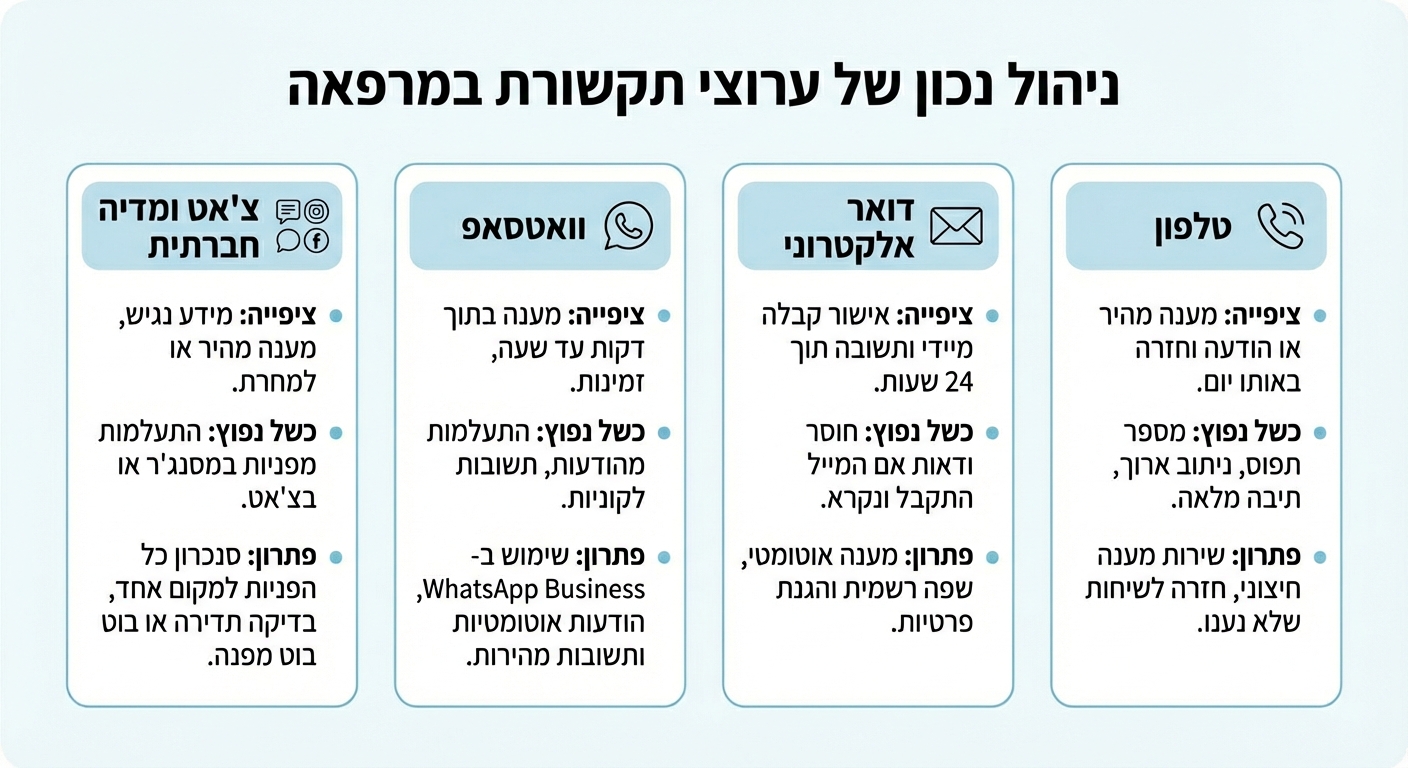
- The expectation: Human answer within a few rings, or at least the ability to leave a message with a promise of quick callback.
- The common failure: "The number is busy" for hours, endless call routing ("Press 1... Press 4..."), or a full voicemail box where you can't leave a message.
- The solution: If the secretary is busy with reception, activate an external human answering service (Call Center) that knows how to take messages professionally. Must return unreturned calls on the same business day.
Email: The Formal and Detailed Channel
Email is usually used for sending medical documents, test results, or complex questions that require detail and aren't immediately urgent.
- The expectation: Immediate (automatic) receipt confirmation and substantive response within 24 hours.
- The common failure: "The black hole." The patient sends an email and doesn't know if it arrived, who read it, and when they'll get an answer.
- The solution: Set up an automatic reply: "We received your inquiry, the medical team will review it and get back to you by...". Maintain formal and respectful language, ensure sensitive medical topics are protected according to privacy laws.
WhatsApp: Always Available
In Israel, WhatsApp is the most powerful communication tool. It's perceived as personal, fast, and immediate. For clinics, WhatsApp is sometimes a "no choice" tool, because patients expect such a communication channel. It's a very effective tool, but also one that can be exhausting.
- The expectation: Response "on the go." The patient sees "blue V" (or knows you've read it) and expects a response within minutes to an hour.
- The common failure: Mixing personal and business, ignoring messages that were "read," or overly terse responses that seem dismissive.
- The solution: Use WhatsApp Business only. This tool allows setting active hours, automatic opening messages ("We're currently closed, we'll be back in the morning"), and quick responses to common questions like clinic address or fasting instructions. This way you can maintain service even when you're not responding immediately.
Website Chat and Social Media Inquiries
These channels usually serve new patients or prospects ("leads"). They're checking the pulse before scheduling an appointment.
- The expectation: Accessible and quick information, fast response to chat messages on social networks - if not the same day, then the next day.
- The common failure: Active Facebook page with beautiful posts, but with Messenger that no one checks for days (at best).
- The solution: Synchronization. All inquiries from social media should funnel to one place that the secretary or clinic manager checks at least twice a day. If you don't have the ability to answer there - don't open the option or set up a bot that directs to WhatsApp/phone.
Clinic Manager = Customer Service Manager
Many doctors fall into the "I'll do everything" trap. They try to treat, answer phones, and send prescriptions simultaneously. The result is doctor burnout and mediocre service for the patient. This is where the responsibility of the clinic manager (or senior secretary) comes into the picture.
The manager's role is not just "scheduling appointments." Their role is managing the patient experience.
The clinic manager must:
- Establish procedures: How quickly do we respond to email? What do we do with an unanswered call? What's the conversation script with an angry patient?
- Filtering and triage: The manager is the gatekeeper. They need to know how to distinguish between a WhatsApp message of "I ran out of prescription" (administrative handling) and "I have chest pressure" (immediate transfer to doctor).
- Using technology: Implementing CRM systems (customer management) that centralize all inquiries in one place, so no patient "falls through the cracks."
- Training: If there's a secretarial team, the manager is responsible for ensuring the language is consistent, patient, and professional across all channels.
When the doctor knows there's a "responsible adult" managing communications, they can focus on what they do best - healing.
Should You Give Patients Your Personal Mobile Number?
This is one of the most charged issues in private medicine (and sometimes in public too). On one hand, giving a personal number is perceived as the pinnacle of service and caring. It creates intimate connection and commitment. On the other hand, it's a sure recipe for burnout, privacy violation, and inability to disconnect from work.
Many doctors who gave their personal number find themselves answering messages at night, or receiving photos of skin rashes during Shabbat dinner. Very quickly, the "service" becomes an annoying burden, which can also harm treatment and overall willingness to continue providing the service.
If you've chosen to be directly available, do it wisely:
- Complete separation: Never use your family's personal phone for work. Purchase a separate device or use dual SIM. This allows you physically and mentally to "turn off the clinic" when you're at home.
- "Cruel" but fair expectation setting: At the first visit, or in email/WhatsApp signature, clearly state: "The number is available for messages between 08:00 and 20:00. In case of medical emergency, contact the hotline or ER, don't wait for a response."
- Educating patients: If a patient sends a non-urgent message on Friday evening, don't answer immediately (unless it's an emergency). If you answer, you've established a norm that you're available 24/7. Answer Sunday morning with a smile. Patients will appreciate you more if you respect your time - it conveys professionalism and not just availability.
- Delegating authority: Connect the business WhatsApp to the clinic manager's computer. She can filter 80% of messages (appointment scheduling, technical questions), and leave only clinical questions for the doctor.
The Future of Service with Artificial Intelligence?
Integrating artificial intelligence (AI) is no longer science fiction, but the next step in managing a modern clinic. Using AI isn't meant to replace the doctor's human touch, but to free the staff from technical tasks so they can provide more personal attention.
We're not quite there at 100%, but there are already interesting applications that can be implemented in the clinic.
Autonomous Voice Agent
The new generation of AI offers "voice agents" that sound almost completely human. Imagine a system that answers the clinic phone at any hour, understands free speech in Hebrew, knows how to schedule appointments directly in your calendar, answer common questions ("Is there parking?", "How much does a consultation cost?") and even identify urgency in the patient's voice and alert the human staff in case of emergency. For the patient, this is service with no waiting time - for the clinic, it's a diligent service representative working 24/7 without burnout (and their salary is quite low too).
Smart Triage
Before the patient arrives or even before the phone call with the doctor, an AI-based chatbot can conduct a smart and thorough preliminary questionnaire on WhatsApp or the website. The system doesn't just collect technical details, but "interviews" the patient about their symptoms in natural and empathetic language. At the end of the conversation, the system presents the doctor with a concise and structured summary, and can even recommend to the patient which test to bring to the appointment. This gives the patient a feeling that "they're being heard" immediately, and saves the doctor precious minutes of collecting basic information inside the room.
Proactive Service Using AI
Instead of waiting for the patient to call when they're sick, AI systems can analyze the clinic's database and generate proactive and personalized outreach. The system will know to identify that a certain patient finished a chronic prescription and send them a message: "We noticed your medication is about to run out, would you like us to prepare a new prescription for you?". Or for example, for patients who haven't visited in six months, the system will send a friendly reminder for a periodic checkup according to their age. This transforms the service from "reactive" to "proactive," which significantly increases patient loyalty.
The Importance of Customer Service in a Clinic
Customer service in a clinic is not a luxury and not a "bonus." It's the connecting thread between the patient's need and the doctor's knowledge. When the service is poor, even the best medical treatment is compromised, because the patient arrives at the examination room stressed, angry, or even frightened.
A clinic that wisely manages its communication channels professionally is a clinic that conveys quality and helps patients feel more comfortable.
You've already mastered the complex clinical tasks. Don't let the "simple" tasks undermine you. Invest in your service system resources, thought, and clear procedures. The return will come not only in the bottom line, but especially in your peace of mind and the sincere gratitude of patients.
Articles in the field of Practice Resources

Telemedicine 2026: The Comprehensive Guide for Doctors – Technologies, Practice and Limitations
The complete guide to telemedicine for doctors: the history of remote medicine, technologies, practical tips and of course - remote medicine with AI.
MedReviews

Managing an Instagram Page for Doctors: A Practical Guide and Tips
Instagram is a search engine for everything. How to turn feed scrolling into clinic appointments? The complete guide for doctors: creating Reels, working with influencers, and proper management
MedReviews

What Patients See About You on Google — and How to Take Control of Your Online Reputation
What do patients see when they search for you on Google? Here's how to manage your digital reputation, deal with misinformation, and take back control.
MedReviews

WhatsApp in the Clinic: A Guide to Smart Usage and Quality Customer Service
WhatsApp in the clinic: A practical guide to smart usage of the popular communication tool. Advantages, disadvantages, tips for proper use and mistakes to avoid.
MedReviews

Physician Branding: How to Turn a New Clinic into a Leading Brand
Proper branding is not "aggressive selling", but rather your way of telling patients who you are, what you believe in, and why they can entrust their health specifically to your hands.
MedReviews

Networking for Doctors: The Complete Guide to Building a Network That Works for You
In today's medical world, networking is no longer just a buzzword reserved for sales reps, but an important strategic tool that you should be utilizing.
MedReviews
Book an Appointment
The service provided through the website is not a medical service. Documentation and sensitive information should only be given to doctors.
About
MedReviews is Israel's most advanced and reliable doctor index, centralizing information and verified reviews on doctors and clinics. Part of Israel's leading review site group, we connect patients seeking quality medical care with top recommended doctors. We achieve this through rigorous verification technology ('crowd wisdom') and advanced filtering mechanisms, providing full transparency in the medical world and enabling informed choices.
Navigation
Contact UsAboutPrivacy PolicyTerms of ServiceAccessibilityMedical articlesPhoto GalleryList your practice on MedReviewsLog inSpecialist Doctors
GynecologistsOrthopedistsOphthalmologistsPlastic SurgeonsDermatologistsCardiologistsENT DoctorsPsychiatristsGeneral SurgeonsOncologistsAesthetic MedicineDentistsDisclaimer
The information and content displayed on this site is intended to provide informative information and expressive opinion on behalf of third parties only they are not a substitute for professional medical advice and should not be relied upon as such advice. Any use of the information on the site requires examination and verification with the relevant parties. Use of the site and its contents is the sole and complete responsibility of the user