

Telemedicine 2026: The Comprehensive Guide for Doctors – Technologies, Practice and Limitations
Practice Resources|January 11, 2026

MedReviews
MedReviews
The official definition of telemedicine is somewhat boring and does not reflect the revolution it has created in the healthcare world, as it focuses on the technical aspects of information transfer rather than on the essence of making care accessible. In practice, this is a profound conceptual shift that allows bringing quality, life-saving medicine directly to the personal and protected space of every patient, regardless of their geographic location.
What is Telemedicine?
Telemedicine is defined by the World Health Organization as the delivery of healthcare services, where distance is a critical factor, by healthcare professionals using information and communication technologies to exchange valid information for diagnosis, treatment, and prevention of diseases and injuries. In simpler terms, it is the ability to provide quality medicine remotely, while bridging geographic and temporal gaps. The term does not refer only to a video call with a doctor, but to a wide range of services that includes remote interpretation of imaging tests, continuous monitoring of chronic patients at home, and inter-professional consultation (doctor to doctor) without the patient's presence.
The History of Telemedicine
The history of telemedicine begins long before the internet era and can be divided into three main stages. The first stage, the "era of analog pioneers," began as early as the late 19th and early 20th centuries. The earliest development is usually documented with the invention of the telephone and radio. In 1905, Willem Einthoven, the father of the ECG, successfully transmitted heart recordings from the hospital to his laboratory, which was several kilometers away, using telephone cables. In the 1920s, magazines like "Radio News" already envisioned the emergence of the "Radio Doctor" - a doctor diagnosing patients through radio and television receivers, a vision that seemed like absolute science fiction at the time but laid the conceptual foundations for the field.
The second stage, which occurred in the second half of the 20th century, was characterized by institutional and military breakthroughs, mainly under the auspices of NASA and academic institutions. In the 1960s and 1970s, the American space agency needed to monitor the physiological indicators of astronauts in space in real time, which led to the development of advanced telemetry technologies. In parallel, projects like STARPAHC tried to apply this technology to treat remote populations in Native American reservations in Arizona. During that period, the Nebraska Psychiatric Institute was a pioneer in using closed-circuit television for psychiatric consultation and medical education, which proved that complex diagnoses can be made even without physical presence in the room.
The third and current stage is the "digital era," which strengthened with the outbreak of COVID-19. With the penetration of high-speed internet and smartphones, telemedicine transformed from an expensive niche to mainstream. However, the most dramatic turning point was the COVID-19 pandemic in 2020. Social distancing constraints and infection risk forced healthcare systems worldwide, including in Israel, to transfer most primary and consultative medicine to virtual platforms almost overnight. What began as a necessity became an accepted standard of care, with healthcare organizations today integrally integrating hybrid services (physical and virtual) as part of routine care, using secure applications, digital medical records, and encrypted video calls.
Types and Technologies of Telemedicine
The world of telemedicine relies on a wide variety of technologies and is usually classified into three main categories, each with different clinical applications and unique technological requirements.
● The first and most familiar type is synchronous medicine (Real-time Telemedicine). This is real-time interaction between the patient and doctor, simulating a regular clinic visit. The central technology here is video calls. Beyond camera and microphone, this category now includes advanced peripheral equipment installed at the patient's location (the Israeli "TytoCare" is a notable example), allowing the doctor to remotely listen to heart and lung sounds, examine the ears, and even photograph the throat in high quality. The use of this equipment transforms the encounter from a consultation only to a partial but significant physical examination.
● The second type is asynchronous medicine (Store-and-Forward). In this method, medical information is collected, stored, and sent to the doctor for interpretation at a later time. This technology is very common in visual fields such as dermatology, radiology, and pathology. The patient or technician photographs a skin lesion, X-ray image, or pathological slide, and the file is securely transferred to a specialist. The great advantage is efficiency: the doctor can review dozens of cases in a short time without the need to coordinate time with the patient.
● The third type is remote monitoring (RPM - Remote Patient Monitoring). This technology enables continuous monitoring of chronic patients at home. It is based on wearable sensors and IoT products. These devices transmit data such as blood pressure, glucose levels, saturation, weight, and ECG directly to the patient's medical record in the cloud. Smart algorithms monitor the information and surface alerts to the medical team only when a deviation from the norm is detected. For example, it is possible to identify deterioration in heart failure days before the patient feels shortness of breath and arrives at the emergency room.
When is it Recommended to Use Telemedicine
The decision when to use telemedicine is no less clinical than logistical. Not every situation is suitable for remote care, and the wisdom is to identify the balance point where technology improves accessibility without compromising treatment safety.
The most recommended use of telemedicine is in managing chronic diseases. Diabetic patients, hypertensive patients, or those with heart failure require frequent monitoring that usually does not require a full physical examination at each visit. The ability to see indicators remotely and discuss medication adjustment with the patient saves valuable time, prevents exposure to infections in the clinic, and improves treatment adherence.
Another area where telemedicine is particularly recommended is mental health. Since psychiatry and psychology are based primarily on conversation, observation, and verbal interaction, the transition to video is natural and almost transparent. Studies have shown that many patients feel more relaxed in their home environment, leading to greater openness in treatment. Additionally, telemedicine allows therapeutic continuity even when the patient is traveling or has difficulty leaving home due to anxiety or depression, thus preventing treatment dropout.
Performing triage and simple follow-ups are also common in remote medicine. In cases of minor complaints such as skin rashes, mild eye infections, or consultation regarding laboratory results, a virtual encounter can provide a quick and efficient response. The system allows the doctor to decide within minutes whether the patient needs an emergency room, a physical visit to the clinic, or if a digital prescription and rest will suffice. This use reduces burdens on emergency rooms and community clinics and allows doctors to dedicate more time to complex cases.
Legal Limitations of Telemedicine
Practicing telemedicine involves complex legal and ethical challenges that every doctor must know in depth. The most important guiding principle is that the standard of care does not change. Legally, the fact that the doctor is not in the same room with the patient does not exempt them from the obligation to provide care at an appropriate professional level. If a certain diagnosis requires abdominal palpation or lung auscultation and cannot be performed remotely, the doctor has a legal obligation to refer the patient for a physical examination.
Another critical legal issue is licensing and geographic boundaries. Traditionally, a license to practice medicine is territorial (granted by a specific state). In the digital age, boundaries blur: is an Israeli doctor allowed to treat via telemedicine a patient who is on vacation in Greece or the USA? Laws vary from country to country (and in the USA from state to state), but the sweeping rule is that what determines is the location where the patient is. Therefore, providing consultation to a patient located in a territory where the doctor does not have a license may expose them to a criminal offense of practicing medicine without a license, as well as loss of professional liability insurance coverage.
A third and critical aspect is privacy and information security. The virtual medical encounter creates extremely sensitive "digital traces." In Israel (according to the Privacy Protection Law and Director General circulars of the Ministry of Health) and in the world (HIPAA regulations in the USA and GDPR in Europe), there is a strict obligation to use only dedicated and secure platforms. Using regular commercial applications that are not properly encrypted (such as video calls on open social networks) to transmit medical information constitutes a violation of the law. In addition, there is an obligation for specific "informed consent" for telemedicine: the doctor must ensure that the patient understands the limitations of the virtual encounter and agrees to it, and this must be documented in the medical record as an integral part of the record.
Use of AI in Telemedicine
The integration of artificial intelligence in telemedicine is one of the most promising and developing fields in modern medicine, and it is expected to change the way doctors work from end to end in the coming years.
AI does not replace the doctor, of course, but serves as an aid that assists in decision-making, process optimization, and error prevention.
One of the main applications is in the field of computerized diagnosis. Deep learning algorithms are now capable of interpreting images of skin lesions or retinal photographs at an accuracy level that equals and sometimes even exceeds that of specialist doctors. For example, the patient can upload a photo of a suspicious mole, and the system will perform initial screening and alert the doctor to the urgency of the case.
In the field of remote monitoring, AI systems analyze huge amounts of data coming from wearable sensors and identify hidden patterns that indicate expected deterioration, allowing the doctor to intervene proactively.
Doctor's office management can also benefit from AI. New AI tools, called "Ambient Scribes" (such as Microsoft's DAX and others), "listen" to the video call between the doctor and patient, transcribe it in real time, separate between speakers, and automatically produce a structured visit summary in the medical record. The doctor only needs to approve the summary.
In addition, AI-based chatbots serve as a "gateway" to the virtual clinic: they question the patient about symptoms, collect relevant information, and prepare it in an organized manner for the doctor even before the call begins, saving valuable time and focusing the clinical encounter.
Common Mistakes by Doctors in Using Telemedicine
Despite the tremendous potential, the transition to telemedicine involves traps that doctors, even very experienced ones, tend to fall into.
● Over-reliance on subjective reporting and giving up too quickly on physical examination. In a video call, it is very easy to "get carried away" by the patient's description and feel that the picture is clear, while skipping suspicious signs that would be revealed in a simple examination. This phenomenon, sometimes called "Diagnostic Drift," can lead to misdiagnosis of acute conditions (such as surgical abdomen or silent pneumonia) as mild viral diseases. Doctors sometimes hesitate to send to the emergency room or for a frontal examination so as not to "disappoint" the patient who requested convenience, and this is a clinical error.
● Giving up non-verbal communication. In a face-to-face encounter, a doctor picks up many nuances from the patient's body language, and vice versa. In video, eye contact breaks frequently and the patient feels that the conversation is unnatural, or that the doctor is not paying attention to them when looking at the medical record on the second computer during the call. Lack of attention to the work environment (background noise, messy room in the background) can damage professional authority and patient trust.
● Technical failures and poor preparation. Starting a visit when the microphone doesn't work, the internet is choppy, or the link wasn't sent, wastes the visit time on solving technical problems instead of on medicine. Beyond that, doctors sometimes forget to verify the patient's identity at the beginning of the call or do not explicitly document that the visit was conducted remotely.
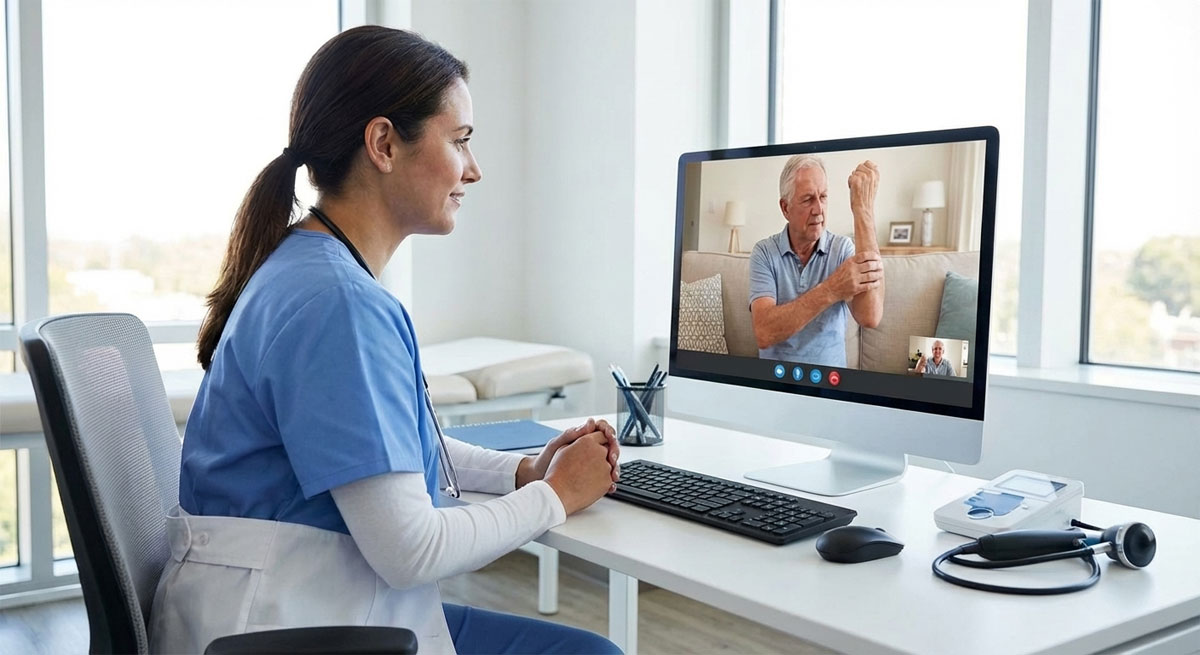
Tips for Proper Use of Telemedicine with Patients
To make the telemedicine encounter efficient, professional, and empathetic, a set of new skills called "Webside Manner" (analogous to Bedside Manner) must be adopted. Here are several practical tips for doctors:
1. Organized and pleasant environment: Ensure good lighting that allows seeing your face, and do not position the light behind you (to prevent a dark silhouette on the face). The background behind you should be neutral and professional - a smooth wall or organized bookshelf is preferable to a kitchen or bedroom. Professional attire (lab coat or formal clothing) helps frame the situation as medical and binding, even if you are working from home.
2. Creating digital eye contact: This is the most difficult skill. For the patient to feel that you are looking at them, you must look at the camera lens and not at their eyes appearing on the screen. It is recommended to position the patient's video window as close as possible to the physical camera on the computer, to minimize the gap in viewing angle.
3. Expectation alignment: At the beginning of the call, explain to the patient what is going to happen. Confirm their identity and physical location (in case of emergency). If you intend to type during the conversation, say so: "I'm looking to the side to review your medical record" or "I'm typing what you're saying." This way, the patient will understand what is happening and won't think you are ignoring them.
4. Guided physical examination: Don't give up on the examination, but perform it through the patient. Instruct them clearly: "Press with your hand on the point that hurts, does it change when you release?", "Bring the camera closer to the rash", "Take a deep breath and blow hard." Involving the patient in the examination empowers them and gives you important clinical indications.
5. Verifying understanding: In telemedicine, the risk of misunderstanding increases. At the end of the visit, ask the patient to repeat the instructions in their own words: "Just to make sure the line was clear, can you tell me how we agreed you would take the medication?" Ensure the patient knows exactly under what conditions they should go to the emergency room or return for a follow-up examination.
Articles in the field of Practice Resources

The Importance of a Doctor Directory: Why Google Business Isn't Enough
Is a Google Business profile enough to manage your reputation? Discover why a professional doctor directory is an essential tool, what its advantages are over Google, and why you must combine both.
MedReviews

SEO for Doctors in the Age of Artificial Intelligence
The world of information search is changing, and SEO for doctors requires a new approach: professional content that creates value for users, consistent online presence, and building authority.
MedReviews

Information Security for Clinics
WhatsApp, personal email, shared passwords — everyday habits that could turn into a cyber incident. Is the data in your clinic truly secure?
MedReviews

Integrating AI in Clinic Management: Innovation, Efficiency, and Everything in Between
How can artificial intelligence streamline your clinic? Discover practical and innovative AI tools for clinic management that will save you time and money while elevating the patient care experience
MedReviews

Excellent Doctor, Mediocre Service? How to Make Your Clinic Excel in Customer Experience Too
Mediocre customer service can undermine you as doctors. Learn how to make your clinic excel in customer experience: tips for managing WhatsApp, email, phone, and more.
MedReviews

Networking for Doctors: The Complete Guide to Building a Network That Works for You
In today's medical world, networking is no longer just a buzzword reserved for sales reps, but an important strategic tool that you should be utilizing.
MedReviews
Book an Appointment
The service provided through the website is not a medical service. Documentation and sensitive information should only be given to doctors.
About
MedReviews is Israel's most advanced and reliable doctor index, centralizing information and verified reviews on doctors and clinics. Part of Israel's leading review site group, we connect patients seeking quality medical care with top recommended doctors. We achieve this through rigorous verification technology ('crowd wisdom') and advanced filtering mechanisms, providing full transparency in the medical world and enabling informed choices.
Navigation
Contact UsAboutPrivacy PolicyTerms of ServiceAccessibilityMedical articlesPhoto GalleryList your practice on MedReviewsLog inSpecialist Doctors
DermatologistsGynecologistsOrthopedistsOphthalmologistsPlastic SurgeonsCardiologistsENT DoctorsPsychiatristsGeneral SurgeonsOncologistsAesthetic MedicineDentistsDisclaimer
The information and content displayed on this site is intended to provide informative information and expressive opinion on behalf of third parties only they are not a substitute for professional medical advice and should not be relied upon as such advice. Any use of the information on the site requires examination and verification with the relevant parties. Use of the site and its contents is the sole and complete responsibility of the user