

Private Doctor or Public Healthcare? The Complete Guide to Making the Right Decision
Practice Resources|December 23, 2025

MedReviews
MedReviews
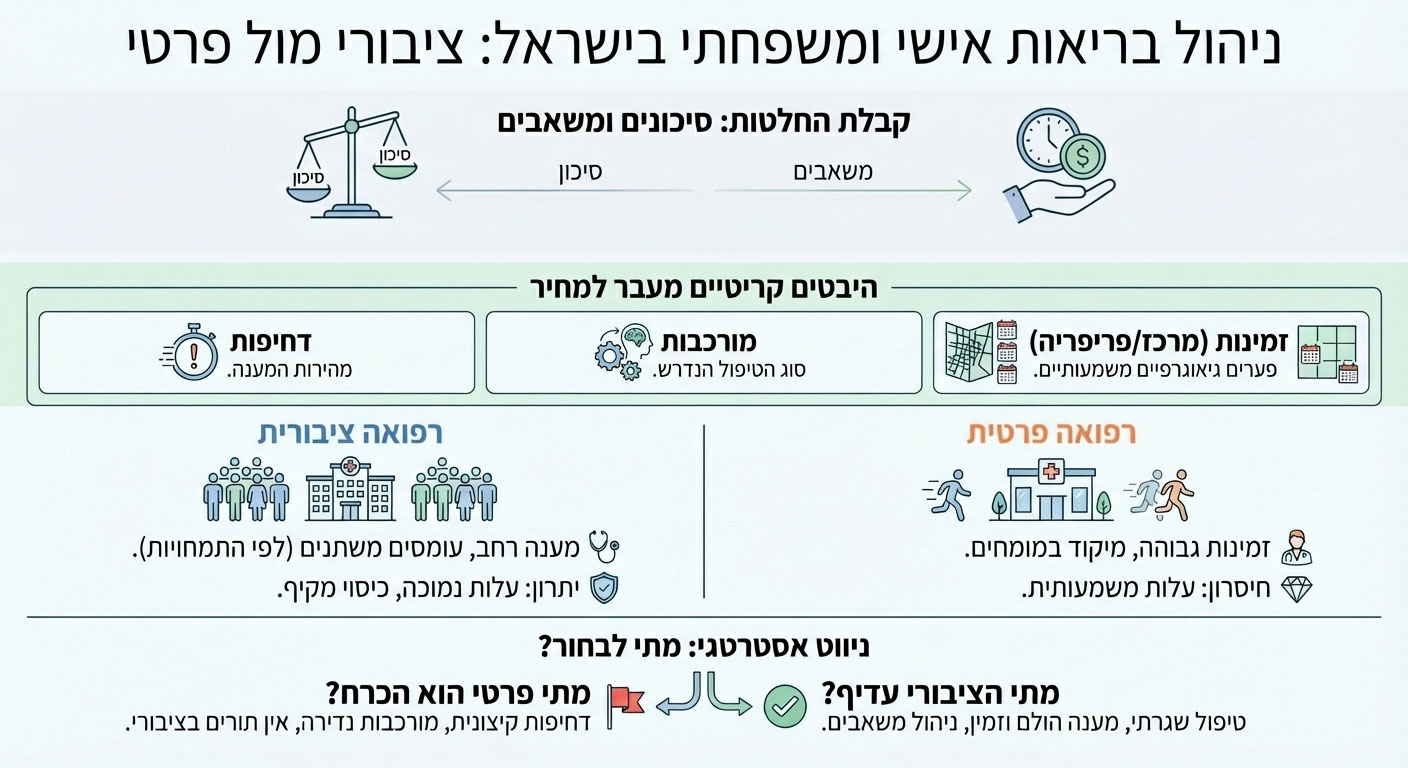
Israel's healthcare system is considered one of the most advanced and best in the world. However, every Israeli knows that moment: the knee pain won't go away, your child needs an ADHD diagnosis, or you simply need a dermatologist urgently – and the earliest appointment at the health fund is in three months (at best), and possibly in another city.
Then we face a dilemma: should we pay out of pocket and turn to private healthcare, or wait patiently for an appointment at the health fund? The answer, like in medicine itself, is not straightforward and depends on various factors. There are numerous considerations and economic and medical implications on the path to making the right decision for you and your family.
The Fundamental Difference Between Private and Public Healthcare
Before diving into the pros and cons, it's important to understand Israel's unique healthcare structure. Public healthcare (health funds) is based on the national health basket. Its enormous advantage is the holistic view: your medical file is centralized in one place, and the system subsidizes almost all treatment.
In contrast, private healthcare operates parallel to public healthcare and is decentralized. It includes independent specialist clinics, private hospitals (such as Assuta or Herzliya Medical Center), and private medical services in hospitals. Here, the patient is a customer who pays directly (or through insurance) for availability, choice, and convenience.
When Should You Wait for a Health Fund Appointment?
In many cases, public healthcare is not only the cheaper option but also the more medically appropriate one. There are quite a few situations where there is no real advantage to seeing a private doctor.
For example:
● Routine follow-up and family medicine: When it comes to winter illnesses, blood pressure monitoring, diabetes, or routine blood tests, the family doctor at the health fund is the best address. They know your history and manage treatment over time.
● Complex treatments requiring a multidisciplinary approach: In oncological diseases (cancer) or complex conditions requiring a combination of several specialists, Israel's public hospitals are among the world leaders. A public hospital's ability to provide the patient with a committee of experts from different fields is an enormous advantage that usually doesn't exist in a single private clinic.
● Financial cost: A visit to the health fund is almost free (except for a symbolic quarterly co-payment of a few dozen shekels). When there's no medical urgency and the wait is reasonable (up to two-three weeks), it's a shame to spend hundreds or thousands of shekels.
When Should You See a Private Doctor?
Turning to private healthcare becomes relevant when the public system fails to provide adequate response in terms of time, choice, or personal attention.
● Significant reduction in waiting times: This is the most common consideration. If you're suffering from acute pain, an annoying rash, or anxiety about test results you received and don't understand, waiting months for an appointment at the health fund is probably not reasonable for you. A private doctor will usually be able to see you within 24-48 hours.
● Choice of surgeon: At the health fund (in the regular public track), you get the surgeon who's on shift. In elective surgeries (non-urgent) such as joint replacement, cataract surgery, or hernia repair, choosing private treatment allows you to choose exactly who will hold the scalpel. For many, this peace of mind is worth the investment.
● Second opinion: When facing a fateful medical decision (should I have surgery? Should I start a specific drug treatment?), it's highly recommended to consult a world-renowned specialist privately. The purpose of the meeting is not necessarily treatment, but getting an additional perspective from someone who isn't bound by the health fund's budget considerations.
● Quality time with the doctor: An average appointment at the health fund lasts about 7 to 10 minutes. In private healthcare, a consultation session usually lasts between 30 to 60 minutes. This allows for depth, asking questions, and better understanding of the medical condition.
Which Type of Medicine Has the Hardest Time Getting Appointments?
Appointment availability with doctors in Israel is a complex matter. Contrary to intuition that says everything is more available in the center of the country, the numbers show a completely different reality. In certain specialties, the heaviest loads are recorded precisely in the center, while in the periphery it's sometimes possible to find almost immediate appointments.
There are several critical "bottlenecks" in the public system, where waiting becomes a task requiring iron patience:
● Mental health: This is the most congested area in the system, especially child and adolescent psychiatry. In cities like Beit Shemesh and Ashkelon, waiting time for a child psychiatrist can reach over a full year. For comparison, in Haifa the situation is much better and you can find an appointment within about two weeks.
● Rheumatology: In Rishon LeZion the waiting time stands at about 8 months, and in Ramat Gan about half a year. In Jerusalem the situation is more balanced with an average wait of about two months.
● Physiotherapy and dentistry: The shortage of appointments for paramedical professions is very prominent in the center. Residents of Ramat Gan, Tel Aviv, or Rishon LeZion have to wait between 5 to 6 months for a simple physiotherapy appointment or tartar cleaning. In contrast, in the Krayot, Acre, or Nahariya availability is good, and sometimes you can schedule an appointment from one day to the next.
● Advanced imaging tests: Even in CT and MRI scans, the periphery wins big in terms of availability. While Tel Aviv records a wait of about 3 months for a CT scan, in Be'er Sheva the systems are more available and sometimes you can be tested as early as the next day.
Tip for shortening appointments: Before rushing to pay a private doctor, try expanding your search range in the health fund app. A 40-minute or hour drive to a neighboring city or different geographic area might shorten your wait by half a year and save you a large financial expense.
Prices and Reimbursements: The Economic Equation
When we talk about a "private doctor," it's important to distinguish between the listed price and the actual cost. Most Israelis hold supplementary insurance from health funds (like "Maccabi Sheli," "Clalit Platinum") or private health insurance from insurance companies.
Consultation: The cost of a visit to a private specialist can range from a few hundred to several thousand shekels (and sometimes more, with famous professors). However, supplementary insurance usually allows for a refund of up to 75-80% of the cost, or paying a low co-payment (about 150-300 NIS) if the doctor is on the "arrangement list."
Surgeries: The cost of private surgery can reach tens of thousands of shekels. Here insurance is critical. Without private insurance or supplementary coverage, the costs are almost impossible for an average household.
Therefore, before scheduling an appointment, it's mandatory to check: Does the doctor work in an arrangement with my health fund? Do I have private insurance that covers "specialist consultation"? A quick check can save hundreds of shekels.
Emergency Medicine: When to Rush to the ER and When to a Private Center?
It's important to distinguish between private consulting medicine and emergency medicine. In case of a life-threatening situation (chest pain, breathing difficulties, head trauma, accident) – the address is always the public emergency room at the nearest hospital. Here private medicine has no meaning, and ER treatment is best for trauma situations.
However, in urgent cases that are not life-threatening (a cut requiring stitches, high fever in a child on Friday evening, suspected fracture), urgent care centers (like "Terem" or "Bikur Rofeh") are an excellent middle solution. They cost money (co-payment of about 100 NIS), but save the exhausting wait in the ER and the risk of infection in the hospital.
So... Private or Public?
The choice between a private and public doctor is risk and resource management. To make the best decision, use the following checklist:
1. Urgency: Can I wait a month? If not – private.
2. Complexity: Is this a one-time consultation or a chronic illness? For chronic illness, a strong public base is preferable.
3. Insurance coverage: Check your policy. If you have significant reimbursement, the "price" of private healthcare drops dramatically and becomes worthwhile.
4. Specific expertise: Are you looking for THE specialist for a rare disease? You'll likely find them faster in a private clinic (sometimes it's the same doctor from the public sector, just in afternoon hours).
At the end of the day, your health is your most important asset. After considering all the parameters, we invite you to our doctors' index, designed to help you find the best specialists, whether through arrangements or privately, so you can receive the best treatment for you – in the shortest time.
Articles in the field of Practice Resources

WhatsApp in the Clinic: A Guide to Smart Usage and Quality Customer Service
WhatsApp in the clinic: A practical guide to smart usage of the popular communication tool. Advantages, disadvantages, tips for proper use and mistakes to avoid.
MedReviews

What Patients See About You on Google — and How to Take Control of Your Online Reputation
What do patients see when they search for you on Google? Here's how to manage your digital reputation, deal with misinformation, and take back control.
MedReviews

SEO for Doctors in the Age of Artificial Intelligence
The world of information search is changing, and SEO for doctors requires a new approach: professional content that creates value for users, consistent online presence, and building authority.
MedReviews

Social Media Marketing for Doctors
Doctors can use social media to share knowledge, build trust, and attract new patients - without losing professionalism. Here's how to do smart and human marketing in the digital world.
MedReviews

Growing Your Private Clinic: How to Attract More Patients
A practical guide to growing your private clinic: from differentiation and digital presence to reputation management, smart networking and essential business metrics
MedReviews

Managing an Instagram Page for Doctors: A Practical Guide and Tips
Instagram is a search engine for everything. How to turn feed scrolling into clinic appointments? The complete guide for doctors: creating Reels, working with influencers, and proper management
MedReviews
Book an Appointment
The service provided through the website is not a medical service. Documentation and sensitive information should only be given to doctors.
About
MedReviews is Israel's most advanced and reliable doctor index, centralizing information and verified reviews on doctors and clinics. Part of Israel's leading review site group, we connect patients seeking quality medical care with top recommended doctors. We achieve this through rigorous verification technology ('crowd wisdom') and advanced filtering mechanisms, providing full transparency in the medical world and enabling informed choices.
Navigation
Contact UsAboutPrivacy PolicyTerms of ServiceAccessibilityMedical articlesPhoto GalleryList your practice on MedReviewsLog inSpecialist Doctors
DermatologistsGynecologistsOrthopedistsOphthalmologistsPlastic SurgeonsCardiologistsENT DoctorsPsychiatristsGeneral SurgeonsOncologistsAesthetic MedicineDentistsDisclaimer
The information and content displayed on this site is intended to provide informative information and expressive opinion on behalf of third parties only they are not a substitute for professional medical advice and should not be relied upon as such advice. Any use of the information on the site requires examination and verification with the relevant parties. Use of the site and its contents is the sole and complete responsibility of the user