

Personalized Medicine: A Paradigm Shift in Healthcare
Health Magazine|May 05, 2026

MedReviews
MedReviews
Medical treatment is based on science - but most often it's based on general science, on studies conducted across broad populations. Drugs are manufactured to suit as many people as possible, and that makes a lot of sense.
However, technology and science are also bringing with them a different kind of medicine - one that is tailored precisely to each individual person, down to the DNA level. Instead of receiving a prescription for a standard drug that has been tested on millions of other people, you can receive truly personal treatment in the fullest sense of the word, tailored exactly to your specifications. The treatment is based on your unique genetic makeup, on the gut bacteria in your stomach, on the continuous heart rate data coming from your smartwatch, and even on a virtual simulation that has predicted in advance how your body will respond to the treatment.
Personalized Medicine, or Precision Medicine, represents a significant shift in the world of healthcare. It marks the dawn of a new era in which medical treatment transforms from a system that reacts to disease into a proactive, intelligent, and individualized system.
From the 'One Size Fits All' Approach to Targeted Clinical Treatment
The foundation of modern Western medicine has rested for centuries on the 'One Size Fits All' approach. Doctors diagnosed patients based on similar clinical symptoms and prescribed them identical treatment based on averages and statistics from mass clinical trials. This meant that if a particular drug was proven effective for 70% of the population, it became the central treatment standard. But what about the remaining 30%? They were left to deal with ineffective treatment, a waste of valuable time, and sometimes even with side effects that could even be life-threatening.
Personalized medicine starts from the premise that every person is a universe in their own right. One patient's illness is not identical to another patient's illness, even if their external manifestations are similar. The unique combination of genetics, epigenetics, environment, nutrition, and lifestyle is what dictates the patient's physiological response to disease and medication. Today, thanks to a drastic drop in the costs of genetic sequencing and thanks to computing power that is available almost everywhere, the transition from uniform medicine to targeted treatment is becoming a daily practice in leading hospitals, especially in complex fields such as oncology and orphan diseases (rare diseases).
Pharmacogenomics: The Precise Drug for Your DNA
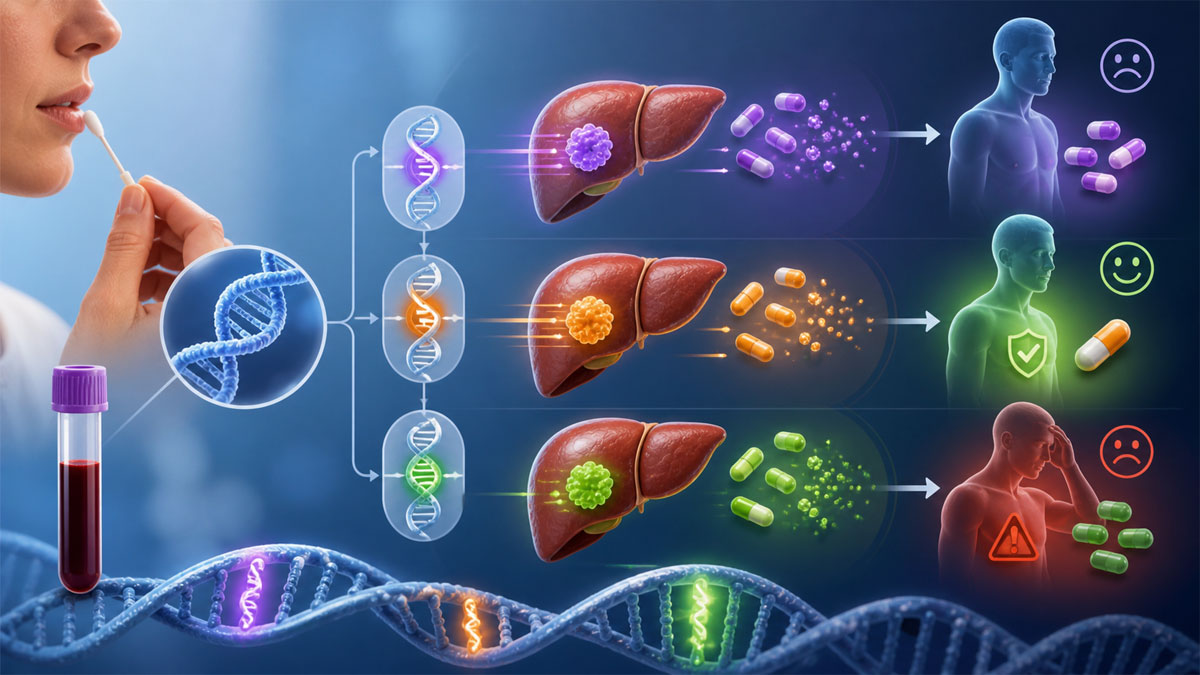
One of the most revolutionary and widespread applications of precision medicine today is called 'Pharmacogenomics' - the connection between the world of pharmacology (the science of drugs) and the world of genomics (the study of genes). The field investigates how specific genetic variations in our DNA dictate the way the body breaks down and absorbs drugs.
How does this work in practice? The human liver produces enzymes whose role is to break down the drugs we take and introduce them into the bloodstream and cells. Due to a tiny genetic mutation, a particular person may produce an enzyme that works at a particularly fast rate, while in another person it will work slower than usual. If the enzyme breaks down the drug too quickly, the drug will be eliminated from the body before it has time to take effect, and the patient will not receive the expected relief. Alternatively, if the enzyme works too slowly, the drug may accumulate in the body to toxic levels, leading to severe side effects.
Through a simple blood or saliva test, doctors receive a 'genetic-pharmaceutical passport.' This is especially critical in psychiatry, where patients with depression or anxiety previously had to undergo an exhausting journey of trial and error with antidepressants until the pill was found that did not cause severe side effects. The same is true in cardiology when determining the precise dosage of blood thinners. Pharmacogenomics enables the right drug to be given, at the right dosage, from day one.
The Digital Twin: A Virtual Simulation of Your Body
If there is one trend that has been exciting the medical innovation community in recent years, it is the 'digital twin' in the world of healthcare. This technology, which originally grew out of the aerospace industry for simulating spacecraft and engines, is now being integrated into the clinic. A medical digital twin is a virtual copy that represents the physiology and biology of a specific patient in real time.
The system draws data from a variety of sources: the electronic medical record, family history, genomics, imaging scans (such as MRI), and a stream of data from wearable sensors. All of these produce a computerized model that represents the organs and tissues.
For example, in oncology, doctors create a digital model of the patient's cancerous tumor. Instead of injecting them with a chemotherapy drug and hoping it will harm only the diseased cells, doctors run hundreds of computerized simulations on the 'twin,' and check in advance which drug cocktail will best suppress the tumor while causing minimal collateral damage. The same is true in pre-surgical cardiology - surgeons 'practice' on a virtual model of the patient's beating heart and formulate a strategy before they have made even a single incision in the physical body.
Genetic Editing Using CRISPR Technology
The discussion of personalized medicine is incomplete without mentioning the most enormous breakthrough in biology of our time - gene editing using the CRISPR system (an acronym for Clustered Regularly Interspaced Short Palindromic Repeats). While traditional drugs try to minimize symptoms, genetic treatment goes straight to the root of the problem, the DNA, and corrects the 'spelling errors' that led to the disease in the first place.
In recent years, the technology has burst beyond the boundaries of research laboratories into the clinic. A historic step was recorded when the U.S. Food and Drug Administration (FDA) began approving CRISPR-based drugs, such as the revolutionary 'Casgevy' treatment that cures patients with Sickle Cell Disease through tailored treatment of their stem cells.
In 2025, we even saw breakthroughs with 'personalized CRISPR treatments.' In a precedent-setting case from that year, medical teams in the U.S. developed within just a few months a gene-editing treatment that was tailored specifically for a single infant who suffered from a rare and fatal metabolic liver disease (CPS1 Deficiency), with no existing treatments available. These developments mark that we are on the verge of an era in which personalized genetic healing will become an accessible product within a short time from the moment of diagnosis.
Artificial Intelligence and Big Data
The true engine that enables all these fantastic capabilities is the combination of big data platforms with advanced artificial intelligence systems. The human body produces astronomical amounts of information. To understand the full set of factors, one must analyze 'Multi-Omics' - a combination of information from genes, proteins, metabolic processes, and the bacterial profile.
It is difficult to impossible for the human brain to draw conclusions or find patterns in such vast amounts of data. Today, medical language models, machine learning, and powerful algorithms scan millions of records within seconds, and provide doctors with extraordinary predictive tools. AI helps to assemble for the patient a recommendation pathway that examines drug responses based on a precise molecular profile, increases the chances of recovery (especially in cancer), and even identifies in advance populations that may be at risk for future diseases before the first symptom has appeared.
Wearable Technology and Continuous Medical Monitoring (Wearables)
Personalized medicine models require continuous data, and advanced wearable technologies meet exactly this need. In the past, smartwatches were content with measuring steps, but today devices such as smart rings and biometric patches function as actual medical laboratories on our wrists.
They are capable of measuring blood pressure, recording an ECG, identifying arrhythmias (such as ventricular fibrillation) during sleep, monitoring blood oxygen levels, and recording stress and temperature indicators. In addition, continuous glucose monitoring (CGM) sensors, without the need for finger pricks, are becoming popular even among healthy people who seek to improve their metabolism. All the data is transmitted securely to the doctor or to the patient's 'digital twin,' which makes it possible to monitor and prevent problems, instead of 'putting out fires' when the pain has already begun.
Personalized Nutrition
We are all familiar with the frustration of choosing a nutrition method that worked miraculously for a close friend, but did not help us at all. The reason for this is simple: the physiology of food digestion differs from person to person. Food considered 'healthy' such as a tomato, sourdough bread, or watermelon may dramatically spike the sugar level of one person, and maintain a balanced and stable sugar level in another person.
The trend of personalized nutrition (Nutrigenomics) abolishes the universal 'magic diet.' Based on tests of the gut bacteria profile, the genetic makeup, and analysis of real-time sugar indicators, a personalized nutritional map can be built for each person. This way, you can know which foods strengthen your immune system, prevent inflammation, and help you maximize your energy levels on a daily basis - all in full personalized adaptation based on data.
The Challenges of Personalized Medicine on the Way to Mainstream
Although the revolution is already here, the road to global welfare is paved with significant challenges. The first and most prominent challenge is the price and accessibility. Developing a personalized genetic drug or creating a digital twin system in the hospital costs a great deal of money. The challenge for biotech companies and public health systems is to make these technologies more accessible, simpler, and cheaper, so that they will not be a luxury for the wealthy alone.
Another burning issue is information security, privacy, and ethics. Our bodies now produce a trail of intimate information in an unprecedented manner - our DNA data, our heart rate during our sleep, and the sequences of diseases we are prone to are stored on servers. Who owns this information? How can insurance corporations be prevented from accessing it so that they will not refuse to insure a person who carries 'problematic' genetics? The world is in the midst of a process of writing the regulation and ethical codes intended to protect consumers.
A Historic Paradigm Shift
Medicine is currently in the midst of a historic paradigm shift. Thanks to the powerful combination of artificial intelligence that finds a needle in a haystack of information, gene-editing technology that corrects the 'code of life' itself, and advanced sensors that keep a finger on the pulse 24/7 - we are witnessing the birth of a new medicine. This medicine does not only 'fix' what exists, but looks to the future, is proactive and precise. Personalized medicine relates to the human body not as a generic product, but as a one-time and unique creation - and enables us to receive the best treatment for us, which is in fact the best treatment.
Articles in the field of Health Magazine

Questions to Ask Your Doctor at the First Appointment
A first meeting with a doctor can be stressful. What questions should you ask about communication, treatment approach, and technology to ensure you're in professional and caring hands?
MedReviews

Private Doctor or Public Healthcare? The Complete Guide to Making the Right Decision
When should you opt for private healthcare and when is it better to wait for a public appointment? A comprehensive overview of appointment availability, costs, reimbursements, and medical considerations for making the best decision.
MedReviews

How to Choose a Dentist and What Not to Compromise On?
How to choose an expert dentist, what not to compromise on, when to turn to a private clinic, and why are we actually afraid of dentists?
MedReviews

How to Find the Right Doctor for You?
How do you find the doctor that best suits you and your preferences? We've prepared a guide for you: from filtering online recommendations and checking specialization, to the appointment itself.
MedReviews

How to Choose a Psychologist Who Is Truly Right for You
Decided to seek psychological treatment? A practical guide to help you navigate: how to verify a licensed psychologist, differences between approaches and costs, private vs. HMO, and how to find the right therapist for you
MedReviews

All the Questions You Should Ask Your Gynecologist
Your first visit to the gynecologist doesn't have to be stressful. Discover how to arrive prepared, ask the right questions, and build a relationship of trust and cooperation.
MedReviews
Book an Appointment
The service provided through the website is not a medical service. Documentation and sensitive information should only be given to doctors.
About
MedReviews is Israel's most advanced and reliable doctor index, centralizing information and verified reviews on doctors and clinics. Part of Israel's leading review site group, we connect patients seeking quality medical care with top recommended doctors. We achieve this through rigorous verification technology ('crowd wisdom') and advanced filtering mechanisms, providing full transparency in the medical world and enabling informed choices.
Navigation
Contact UsAboutPrivacy PolicyTerms of ServiceAccessibilityMedical articlesPhoto GalleryList your practice on MedReviewsLog inSpecialist Doctors
DermatologistsGynecologistsOrthopedistsOphthalmologistsPlastic SurgeonsCardiologistsENT DoctorsPsychiatristsGeneral SurgeonsOncologistsAesthetic MedicineDentistsDisclaimer
The information and content displayed on this site is intended to provide informative information and expressive opinion on behalf of third parties only they are not a substitute for professional medical advice and should not be relied upon as such advice. Any use of the information on the site requires examination and verification with the relevant parties. Use of the site and its contents is the sole and complete responsibility of the user